It Doesn’t Have to Be This Way

Images of broken light which dance before me like a million eyes
They call me on and on across the universe
Thoughts meander like a restless wind
Inside a letter box they
Tumble blindly as they make their way
Across the universe

Jai guru deva om
Nothing’s gonna change my world

–  “Across the Universe” by The Beatles

IMG_2037

This is one of my scholars walking with a Baltimore City Police Officer. Never did I think I would see this sight. One of my girls, who has had numerous traumatizing interactions with cops, knows people who’ve been blatantly and wrongfully mistreated by cops, walking next to one talking about her goals for the future. This is hardly a problem solved. But it’s a start. Maybe a tiny one. But a start nonetheless. And it makes me think.

Dear Humans,

It doesn’t have to be this way.

Let that sink in. Let it flow from your corneas, lenses, retinas and to your brain. Let it tumble down from your brain and into your heart. And when your heart and your brain are ready to work together allow, “It doesn’t have to be this way” to dribble to your toes and feet and roll down to your fingertips and hands. Your heart and your brain and your hands and feet can all work together to prove that it doesn’t have to be this way.

Humans, sometimes I think that all we need to hear is that the way we’re proceeding is not the only option. Sometimes we just need to remember that stuck-ness is often more of a choice than an imprisonment. “I can’t do this because I have never done it before” is not valid reasoning. And “That’s not how we do things” or “But this is what I am used to” are lame excuses.

This thought, It doesn’t have to be this way, came to me the other day in a restorative yoga class. We were in a katonah version of half pigeon with all kinds of props–typically a very still posture–the teacher said to us, “Feel free to move around and keep playing with how this feels. Just because you’ve arrived doesn’t mean you need to remain the way you are.” Now, humans, I know she meant this in a totally literal way. A still posture doesn’t need to stay completely still and in yoga we get no points for being the most stagnant. It makes us no more peaceful than the chick on the next mat over. But I immediately thought of all of the ways that, we, we people, can be so stuck in our ways and our patterns and our jobs and our relationships and our “two cream, three sugar.”

And really, what more makes us human that our dynamic nature? Our ability to evolve? Our, quite honestly, lack of control of our own evolution: aging and growing and shrinking and graying and wrinkling and changing?

So, just because you’ve arrived, doesn’t mean you need to remain there. It doesn’t have to be this way.

When I thought about this, I did some googling. I came across an article called “America Doesn’t Have to Be Like This.” In it, the author, an Isreali American, Ilana Masad talks about our American political system, “It didn’t have to be this way, but this is how it is: there are still myriad ways in which minorities and marginalized people in the US suffer systemic oppression, and there is still so much money in politics that it boggles the mind and seems like an obvious, glaring flaw in the system. And so, what to do?”

And boy, do I hear her! I remember visiting the Vatican for the first time after 20 years of being Catholic and thinking of all of the pleas for the poor box and donations at church when the Catholic Mecca of sorts is quite literally coated in gold.

So it’s amazing, in the real sense of the word, that we have created a political system in which campaigns raise millions or billions of dollars for ads and attack ads; candidates spend years and careers preparing; and teams of people work toward one election. All of this to elect a person to “help” better any given neighborhood, town, city, county, state, country when that very money, those very resources, that immense energy could be enough to do just that.

And because it’s been this way, it keeps being this way. But does it have to?

I don’t pretend to have the solution to our pitiful political system and the most I’ve decided about the Vatican is that we could get a really tall ladder and some of those paint scraper things and just get some of that gold off of that ceiling. We will trade the gold for cash and give out micro loans in the world’s poorest communities.

But we all have ways in our lives that we can adjust, revise, adapt, bend, re-try, start over, etc. So maybe this mantra can help lead you where you’re headed or at the very least, shake you out of a pattern that isn’t serving you.

And as much as I loved “Across the Universe,” I think The Beatles were wrong when they said “nothing’s gonna change my world.” Frankly, they were on LSD by then and praising the Maharaja.

I’d argue that you are gonna change your world.


In the name of growth and dynamism and acceptance and love and forgiveness,

Amandy

IMG_1715

One optimistic (sort of) use of boarded windows and doors. #Baltimore

PS: Here are some tangible ways to make changes that I’ve shared with you in the past.

https://writingamandy.com/2017/11/10/let-there-b-more-love/

https://writingamandy.com/2018/07/06/paint-baltimore-kind/

The Changing Legacy of 33rd Street

Image result for memorial stadium

I grew up four blocks and well-thrown baseball away from where Memorial Stadium used to be. This doesn’t mean much to most of the world but this is how I describe my parents’ house to Baltimore natives. In response there’s always a nod, a smile, and many times a story about seeing the Orioles or Colts win a big one on that hallowed ground during simpler days.

Baltimore is a city in which people locate landmarks and neighborhoods by what “used to be there”—not because there isn’t a replacement or we haven’t seen the new occupant yet—we are a people who cling to tradition and memory. We know this about one another and out of respect we give our directions based on the land uses of yore. It’s an unwritten language, just like the long drawl of the letter “o” that occurs when a Baltimorean’s lower jaw juts beyond the upper, particularly unabashedly during the National Anthem. “OH” say can you see?

Our neighborhood, Ednor Gardens Lakeside, sits in Northeast Baltimore one asphalt hill away from what is now a diversely populated YMCA and clusters of affordable housing for the elderly. The website for Ednor Gardens Lakeside scrolls through pictures of some of its Tudor-style homes wrapped in ivy or enveloped by hydrangeas, none of which look like the middle-of-group-row house where my mom used to read me Goodnight Moon in the early ‘90s. The site doesn’t display the water filtration plant that’s been littered with bulldozers and jersey walls for a decade. It omits images of the speed humps the city installed to stop gangs like the 12 O’clock Boys from ripping wheelies on dirt bikes down residential streets. And, maybe most dishonestly, it fails to include a picture of the spot where Memorial Stadium used to be.

Despite the glaring omission, as a YMCA and low-income community for the elderly, this place undoubtedly still carries on the great legacy of Baltimore’s Memorial Stadium, home of the Orioles, the Colts, and the Ravens, the “Old Gray Lady of 33rd Street” though the “Lady” is no longer home.

The square of land that hosted Baltimore’s famous greats sits three blocks by three blocks in Ednor Gardens Lakeside. From the north on 36th Street peering above a row of leafy bushes, the downtown business district, three miles to the south, appears almost peaceful. From here soft clouds ripple gently around Baltimore’s tallest office buildings. Just over these bushes though, the immediate view has changed much more in 10 years than the distant—from a half-century of professional feats at Memorial to the recent decade where thousands of amateurs stretch in yoga, backstroke in the pool, and strike up strange conversations in the locker room.

On three sides of the square, stone and brick row homes stare at the space as they have since just after World War I. Most are well maintained. Perhaps speaking for their residents, they look complacent. They’ve watched their larger front yard greatly transform with little say .

The fourth side faces 33rd Street where treadmill runners behind wide panes of glass view cars going too fast past the building that used to be Eastern High School—huge and brick with sides that reach out like arms toward an old friend at right angles.

Just a few sidewalk tiles down was hallowed ground, if hallowed ground can be moved to past tense. The proud façade of Memorial Stadium stood there for almost 50 years mourning the dead and, for a time, immortalizing them in art deco lettering. Elongated silver letters—maybe better suited for a diner sign—solemnized those, “who so valiantly fought in the world wars with eternal gratitude to those who made the supreme sacrifice to preserve equality and freedom throughout the world.” The wall’s lone salvaged sentence is reassembled at Camden Yards, the Orioles’ current home, reading, “Time will not dim the glory of their deeds.”

While time may not have touched the glory, the memorial itself is long gone. Memorial Stadium, as of 1950, featured the famous wall that was cause for controversy during the already controversial demolition. Local writer and filmmaker Charles Cohen wanted to capture that glory in its final years, months, and days. As co-creator of “The Last Season,” a documentary about the stadium’s end, Cohen spent two years interviewing Baltimoreans’ reactions to the end of their Memorial Stadium including its celebrated wall.

The wall, a central focus of the film, was slated to be the one part of the stadium remaining when the rest of the structure met its final wrecking ball in 2002. Cohen interviews fans coming to see an old friend a final time as they pillage seats, haul urinals, and lug Miller Lite signs. Some cry as they reminisce and see what remains. The fans in “The Last Season” look at a ghost, their memories fighting against the glorified memories of the stadium preserved in their heads.

Through making the film, Cohen says, he saw a “strange window into the Baltimore psyche.” Baltimore is an odd place, he says, “with that Brooklyn kind of grit but a lackadaisical viewpoint.” Baltimore clings to its past in a nostalgic way but its residents are often too complacent or laid-back to really fight for it. Like our old streetcars and steamships, Memorial Stadium slipped into disrepair and became a part of Baltimore’s history. There were 11th hour protesters. Citizens lobbied their elected officials. But where were they for so long as the structure sat rotting and unused for years?

With the rest of the stadium in piles like the makings of a giant bird’s nest, “The Last Season” shows fans celebrating the salvaged wall. The chorus of “at least they’re keeping the wall,” echoes across the site as Cohen interviews Baltimoreans. Then, despite the $750,000 in additional funds used for a special procedure involving a diamond blade saw and the wishes of many to salvage the famed memorial wall, it too was leveled following the rest of its body in 2002.

For some, the total demolition meant a promising community and business opportunity, an infuriating murder of a historic landmark for many others. In Cohen’s documentary, both sides lay out their positions but the more unforgettable, the more heartfelt, the more emotive are those who rattle off memories like its roll call, with tears in their eyes, their feet standing on scraggly weeds that blanket a once manicured field. Games with a late family member, claims from the mayor at the time to “respect” constituents’ desires, memories of the Orioles final game when two men dug up home plate with pick axes, hacking, hacking, hacking for nearly thirty minutes, unearthing and ripping out the heart of the old stadium to cart it off to the Os’ new home. Many interviewees start by talking into the camera and then morosely gaze out at what the stadium had become: vacant, forgotten, and a memory of its former self, barely deserving of an address there on 33rd Street.

In a different time, it didn’t dip below 60 degrees in Baltimore on Saturday, September 29, 1945 when 14-year-old Mary Lou Luczkowski and some of her friends attended a local high school football game at what was then called Municipal Stadium. She was a beauty—her curled brown hair bounced on her shoulders, her bright Polish eyes smiled when her mouth did. She was petite, good-humored, and smart, having skipped a grade in elementary school. It was during that Poly-Patterson High game right there on 33rd Street that she met 17-year-old Vince Papa, thin-faced and Sicilian and from a different part of town. To hear her tell it, his charisma and politeness won her over that day in the massive oval structure on 33rd Street.

Just a year earlier, the Baltimore Orioles, then a minor league team, moved their home to Municipal when their own Oriole Park and its wooden stands went up in flames overnight on July 3rd into the 4th, 1944. Municipal, built in 1922, was the choice venue for local and collegiate sports at the time. The game where my grandparents Mary Lou and Vince met was just another sporting event in a blue-collar town that hadn’t yet earned professional teams of its own.

The city gradually built its reputation as the home of sports enthusiasts and the Baltimore Colts football team stomped into 33rd Street in 1947. Seven years later in 1954 Granpop had finished up his military service. He had already won over and married Grammom and they were talking about children when the Baltimore Orioles came flying back to town, this time as a pro team. Vince, Mary Lou, and Baltimore finally had their team.

With the same address, Memorial Stadium replaced Municipal in 1950, the city opting for a more enclosed and modern structure. With a capacity of 31,000 spectators, 1954 marked the first season for the major league birds, a team from St. Louis in pursuit of a better market, and landed on there 33rd Street. Memorial Stadium was soon solidified as a sports Mecca in the middle of a residential neighborhood. It quickly earned the nickname, “World’s Largest Outdoor Insane Asylum.” And the Orioles and Colts were home.

Decades later when my parents bought their house around the way from Memorial in 1986, the stadium’s proximity was not a selling point, just a coincidence. Still, they both remember the days you could walk in unnoticed, for free after about the fourth inning while others freeloaded by watching from a fence with a view of the field. The stadium was a constant neighbor for the first decade and a half of their marriage.

Personally I can remember the lights sticking up over the hill at the end of our block. Cohen compares them to a black erector set and, if I look down the end of our street and then close my eyes, I can still see the glow from the top of that hill. White bursts erupting between black metal—an announcement of “game time” for everyone within an earshot range of a mile in every direction.

If the wind was right, we could hear players being called to bat from the stadium and right through our open windows. No air conditioning, just a hot Baltimore summer cooking our house and the echoed announcement of whatever Oriole was on deck. “Cal al al…Rip ip ip…ken ken kennnn.”

Most clearly, I can recall Jon Miller’s booming summertime voice throughout our house calling the Orioles’ plays over the constant drone of the huge metal fan that was once my height. Feats of the hometown team bounced off our walls emanating from an old silver radio, antenna pointing up as my dad did housework in cutoff jeans. I remember Dad explaining to me what Miller meant with his famous, “Give that fan a contract!” and Miller’s voice was like an anthem.

When the Orioles moved to Camden Yards in downtown Baltimore in 1992, the neighborhood felt a contradictory mixture of anger and peace, misery and relief. For a short time the stadium housed a championship Canadian Football League team, the Baltimore Stallions, who, despite success, failed to quench the football thirst of the city. So when Baltimore adopted the Cleveland Browns in 1996, in contrast to the way the Colts had been stolen from us in ’80, old trusty Memorial Stadium stepped up like the Giving Tree, happy to be needed once again. And all over, the lights over the hill beamed and loudspeaker hollers sailed to our front porch.

I remember only frustration on Sundays when my mom couldn’t find parking for “The Marshmallow,” her white hatchback Honda. We’d come home from church and she’d roar the manual engine around Ednor Gardens’ small streets talking about the “durn Ravens fans,” which we all are now. Impromptu cookouts sent smoke up from the grass lining our streets. Cans and tinfoil then lay abandoned after a mad rush to the gridiron. My mom recalls purposefully going out to pick up the spectators’ trash as they tailgated, giving them a mirror to see their disregard for our neighborhood.

By 1998, the Ravens had built their own nest, shiny and new and five whole miles from us. Parking woes were over, those lights stayed dark, and the voices were much too far to carry to our front porch. Memorial Stadium and its spot on 33rd Street were benched once again.

In the early 2000s the battle over the fate of the ground became fierce with Baltimore’s former mayor William Donald Schaffer fighting to keep the old stadium and the mayor at the time Martin O’Malley arguing for its removal. As Cohen shows in “The Last Season,” politicians fought for their constituents and seemingly for their own nostalgia in some cases.

My mom, in favor of the demolition, argued that as a resident of the neighborhood, a vagrant building that spanned 9 square blocks needed to go. She talked about friends from “the suburbs” (a phrase she always says with disdain) who wanted the stadium intact, “while we had been living here with this giant empty shell down the block.”

“It was time,” she says, then finds her way into a story about waiting in the parking lot in ’82 or ‘83 with one of her students, a boy with severe cerebral palsy. “Tyrone and I ended up in the elevator with Rex Barney [a former baseball player and Orioles announcer]. We asked where Eddie Murray parked and he actually told us,” she says.

On the steamy blacktop, Mom stood while 10-year-old Tyrone excitedly sat in his wheelchair with twisted limbs and bright eyes and they waited by Murray’s car. At the time, Murray was an All-Star and Gold Glove winner. He had been American League Rookie of the Year in 1977 but was known for his shy nature with the media and fans. Murray walked out of Memorial in civilian clothes expecting to drive away in his dark car, unperturbed; instead, he took one look at Tyrone and signed a ball for them graciously—and I can tell in her voice that she’s proud of this. She remembers snapshots like this fondly, but still thinks that in the early 2000s, “it was time.”

The YMCA, she says, serves everybody in the community, the way Memorial Stadium did, just in a different way. And there is the dichotomy of a people who are passionate about a ballpark and their history, but want growth for their city. How can Baltimore move onto the next without bidding adieu to the last? The month it finally opened in 2004, we signed up for a family membership to the new YMCA. My mom, dad, sister, and I have been working out there ever since.

“What temperature do you like to swim in?” a rotund, naked stranger asked of me recently.

“Oh I get used to it so quickly, it doesn’t really matter to me,” I said tightening my towel around my chest. The rest of my consciousness processed the familiar situation, and looked for a way to avoid staring at her bare body. I aimed my eyes at my book, but my place on the page pointed my gaze toward her stretched and drooping breasts. As I pierced my eyes through the paper, she began thoroughly toweling off, rubbing every crevice two feet from where I sat with my innocent little book. I crossed and uncrossed my legs, and crossed them again, keeping my towel over the same parts she flaunted.

“Haven’t been swimming in six weeks,” she continued as she bent down to wipe her legs. Her butt seemed to stop, and take a look at me, before widening as she lowered, then narrowing as she came back up.

I formed some reply about the therapeutic nature of swimming as she turned her body to face me. A small patch of pubic hair peeked in and out of sight as she shimmied the towel back and forth across her. The women’s sauna at the YMCA is rife with scenes like this one.

In that sauna, I have opened pores, polished off novels, held numerous conversations with strange naked people, caught a splinter in my butt, received an invitation to a line-dancing class. All within feet of where guys like Brooks Robinson, Johnny Unitas, and Cal Ripken put Baltimore on the map, where in the ‘50s, kids could be dropped off by their parents to watch the game unsupervised for 35 cents with a coupon from a box of cookies. A baseline away from where knuckleball pitcher Hoyt Wilhelm put up a no-hitter against the Yanks in September 1958 and the Colts hosted the NFL Championship in ’59, beating the Giants for the second consecutive year. Where in 1976 a plane crashed into the upper deck injuring no one because the Colts were losing so badly to the Steelers that everyone around had already left. Where, in teenaged innocence, my grandparents saw one another for the first time, and just around the way from where my parents made a life for us.Image result for waverly ymca
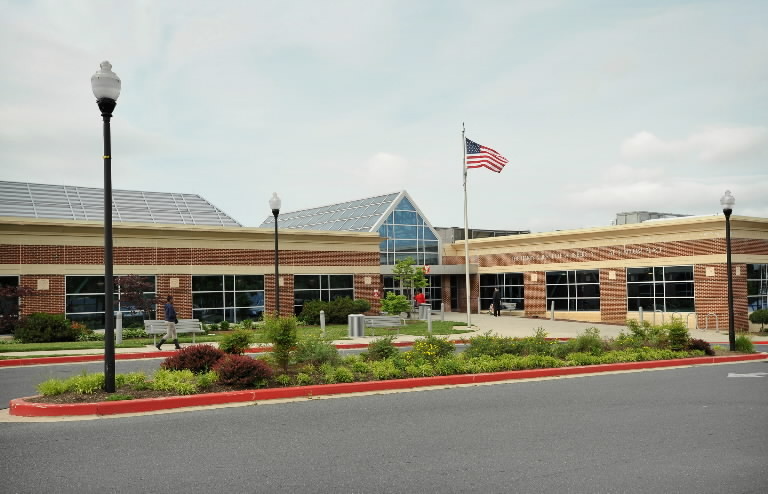
This YMCA serves Baltimore City with community outreach and engagement, programs for the elderly, summer camp for the young, after school care, nutrition education, a fitness center and pool, and so much more. The Y houses 4,000 “units” of membership (each unit can be as large as a family). I have played basketball there with my dad and run into old friends and harvest adrenaline. It’s a comfort after a long day to read a good book on the elliptical and then sweat in the sauna. I see the diversity of the people who go there and the wide range of activities that help the neighborhood where I grew up. While I know the loss of the stadium was heartbreaking for many Baltimoreans, this YMCA picks up where that community landmark left off and it serves the city. Athletes still play there; most are just significantly shorter and take many less steroids.

On a recent visit, I sat on a metal bench behind the new baseball park put in by the Cal Ripken Sr. Foundation in 2010. Home plate sits exactly where home plate sat in 1991 when the last O’s game was played here. Looking beyond the field, leafless trees reach with tendrils pointed skyward, the elderly housing complexes dot the perimeter where people once parked their Chevy Novas and Ford Pintos. The turf field looks impossibly green for February. And ever faithful, the row homes look down.

A girls’ lacrosse team practiced that day, running suicides as the coach yelled and whistled. Cries of “Oh mah gawwwd,” rang out and other girls yelled, “Stop complainin’!”

“Leave it all on the field! Leave it all on the field! Leave it all on the field!” hollered the coach. And I thought about all the Baltimoreans who had done just that. Right here. They left it all on the field. And I re-wrote something I’ve said so often to explain my neighborhood, “I grew up down the street from the 33rd Street YMCA.”


Works Cited

  1. Alexander, Gregory J., and Paul Kelsey Williams. Lost Baltimore. London: Anova, 2013. Print.
  2. Brown, Bob. House of Magic. Baltimore: The Orioles, Inc., 1991. Print.
  3. Cohen, Charles. Phone interview. 13 February 2014.
  4. Doran, Nancy. Personal interview. 15 February 2014.
  5. Eby, Skip. Phone interview. 13 February 2014.
  6. James, Mary Lou. Personal interview. 15 February 2014.
  7. The Last Season. Charles Cohen and Joseph Mathew. Eyesore, 2002. Film.
  8. Papa, Michael. Personal interview. 28 February 2014.
  9. YMCA of Central Maryland website. 16 February 2014. Web.


Gray Areas or “Would you rather?”


IMG_2446

The space between the gray areas.

At the Red Canoe Cafe in Hamilton, Baltimore City, the tip jar is always a “Would you rather…?” situation. You vote with your tip—highly motivational. It’ll be something like apples or bananas or Barney and Friends or Sesame Street, maybe a day at the beach or a day on the mountains or waterskiing vs. snow skiing. They’re easy choices that people feel unwarrantedly passionate about.

When I am traveling with Chas, I find myself in these “Would you rather” situations quite often. First off, Chas is our vice president in charge of planning but he also always asks for my opinion and when we’re traveling we have so many more choices than we typically have in everyday life. This begins when we select our destinations, though for our current trip, we allowed that to be almost completely dictated by finding the lowest flight prices for a desirable location during this week I have off from school.

Choice is a luxury, right? If we have the ability to choose things, it’s often because something is going right for us. I’m not talking about apples vs. bananas here (though bananas are cheaper) rather, choice comes when we have enough money to choose one mode of transportation or another, we have the ability to choose one journey or another, selecting a university, being able to choose where we live and in what type of house.

I’m increasingly more aware of the luxury of choice with the more time I spend with my kids from school. If you grow up in poverty, choice is limited. Choice in schools, choice in transportation, choice in housing and free time and so many more ripple effects that result from those absences of choice. The lack of these “black and white” choices are why I see so many things in gray, especially the older I get. As a child, everything is black and white. Strangers are scary. Adults are stable and always choose right. History books are trustworthy. Politicians are smart. Airplanes on crash over bodies of water. The more life you live, the less things are black and white. Gray becomes home.

For example, to bring it back to poverty in Baltimore: it’s not one’s simple choice to remain in poverty or to rise out of it. It’s not a simple choice to trudge through high school with mediocre grades, making it to the end of twelfth grade with one class standing in the way of a diploma or to launch one’s way through high school with straight As and into a great college with a scholarship. That’s not one easy choice. It’s not black vs. white. The cycle of poverty is as gray as an elephant’s back. Those diverging paths include thousands or millions of tiny choices influenced by one’s family and friends and the people on the corner who she walks by on the way to school and the boyfriend and her boyfriend’s mom and so on. But this blog isn’t about those gray areas. I think we should live there in that gray area most of the time and sometimes, it’s kind of fun to take a break.

So, here’s a pretty black and white “Would you rather” list ala Amandy. I’d love you to weigh in too.


Airbnb or hotel/hostel

I should paint this picture from a recent experience first, or the choice is unfair. I prefer Airbnb. Almost always. I love seeing the homes, the neighborhoods, talking to the people, getting reviewed, seeing the maps, looking at the fine touches. Also, quite simply, the Airbnb website makes sense to me. Actual humans respond, there are photos, it’s a bit like shopping for real estate.

This week, Chas and I have been in various places in Scandinavia and have mostly stayed in Airbnb spots. We did stay in one hostel. A former prison, turned hostel. Put your thoughts on just that aside for now because this is more about booking than anything. Because of the random nature of the site I used to book the prison hostel (a typical hotel finder website), I booked the wrong prison hostel in Sweden, meaning there are at least two prison hostels in Sweden and I selected and paid for the wrong one. This would not have happened with Airbnb. Fair preference? Maybe not. But I prefer Airbnb.

Still or sparkling

Absolutely still. Sparkling water is a nice treat when I am hungry but it’s too close to dinner time. But in terms of refreshment and replenishment, sparkling has nothing on still.

Red white or white wine

Seventy five percent of the time, I choose white wine. Red wine looks bad on teeth, feels weird in my belly, and is significantly more likely to give me a headache. Give me a sauvignon blanc any day.

Manicure or pedicure

This is tricky. For self-care, definitely a pedicure. Pedicures feel nice and include a mini leg massage. Manicures are more about walking away fancy. Oddly, I think I prefer walking away fancy and choose mani over pedi. While it’s a time and financial commitment, both is best.

 The Bachelor or The Bachelorette

While I shamelessly watch both and have for years, I prefer watching The Bachelorette. Not only does it come out in spring, a happy time generally, I love seeing all of the bros in incredibly vulnerable situations. I like watching them pick one another apart and lose their patience and lie and then get caught. It’s a great case study in good looking idiots.

Fiction or nonfiction

Obviously, I write nonfiction. When I try to write fiction, I think I sound ridiculous. Nothing seems real or believable or authentic. Nonfiction just feels right to me. And this world offers plenty of stories.

When I read, I have a slight preference for fiction. For listening to podcasts or watching TV, nonfiction hands down.

Tea or coffee

Coffee is my lifeblood. It makes the world make sense. It softens my sharp edges, gives me power, makes the world make sense, at least enough.

Ketchup or mustard

I hate ketchup. It’s so distant from the tomato, so sugary, so unnecessary. How long ago were those tomatoes grown? At Oriole games during the condiment race, I will always root for mustard or relish. Given the choice between ketchup or mustard, mustard every time.

Window seat or aisle seat

I get why people prefer the aisle, but I want the window. I want something to lean on for naps. The aisle offers no rest for the weary and planes make me very weary.

Kevin Costner or Kevin Bacon

Kevin Costner has been my older man crush for years. Think For the Love of the Game Kevin Costner. He’s a baseball pitcher who’s unapproachable and hard-edged but certainly soft and cuddly on the inside. Think Message in a Bottle Kevin Costner. He’s a waterman, gruff, and alone. Okay, okay, so he always plays the same character. But it’s a character I love.

And something about the space between Kevin Bacon’s nose and top lip weirds me out. All I can do is stare at it. Costner has got my vote.

Right or left side of the bed

This is a trick question, my choice will always be wherever the reading lamp is and wherever there’s a side table for my water.

Doctor or Dentist

If you’ve met my dentist (and an strange number of you actually have), you’ll already know my answer. I will take dentist over doctor any day. The doctor includes all sorts of unknowns and chances. The wait at the doctor is always head-scratching-long to me too. I mean, why bother having appointments? At the dentist, Dr. Bryan always takes me right back. The dentist lasts a predictable amount of time and there are a predictable set of activities. With the doctor, the clock is irrelevant. There could be shots or blood draws or maybe you lost an inch of height. I’ll take the dentist any day.


The gray area is mostly where I’ll stay. But when I get to choose black or white, I’m happy to and I can be pretty polarized. Would you rathers are a luxury, though. And while I stay in the gray, I promise to remember that.


A Newport Ad, The Internet, and Us

This week we received a tri-fold postcard advertisement in the mail for Newport Lights. We keep our recycling bins on the front porch (because we’re classy, but also green) so I usually pull ads out of the mailbox and drop them right into the recycling bin. This one was a strange exception though. I had to bring it inside and show Chas. What kind of an anachronism is a paper ad for cigarettes being mailed to my house? It contains an invite to make your own video on the Newport website, descriptions of two contests to win trips, one to New York City and the other to Hollywood, and coupons for cigarettes. How desperate have we become? And by “we,” I mean Reynolds Tobacco Company.

One thing that strikes me the most is that thousands of people must receive this ad. But who actually cares?

It’s printed on nice paper. It’s visually appealing. But who are these people who take these coupons and buy Newports? Is the goal to get people to start smoking? In the year of our lord, two thousand and eighteen? Are we serious? Am I supposed to think “Ooo $4 off! I think I’ll pick up this deadly habit and run with it!”?

What are we supposed to care about anymore? In a given “normal” American day, I receive two or three snail mail ads; absentmindedly view hundreds of online ads on a work day; if it’s a Bachelor(ette/in Paradise) day then a few repeated TV ads on abc.com; when I take 83, maybe eight or nine billboards; and probably more I’m not thinking about. It amazes me that our brains even weed through enough to prove that it’s worth buying ad time and space. But they must work because according to this top hit on google, TV advertising alone is a $71 billion per year industry. No way “they’d” be spending that much money on something ineffective.

So what’s urgent anymore? There are so many people and companies and devices all vying for our attention. It’s like little visual and audio explosions going off all around us all the time to the extent that we don’t even know how to deal and in some cases care–kind of like the Trump presidency.

———

So while I am squarely a millennial, I now have social media (as of the past 10 months), and I am technology literate and a very fast typer, here are my pet peeves about the digital age, a time that makes paper cigarette ads look quaint and surprisingly, almost endearing.

Passwords

How many passwords and versions of the same password do we all have by now? Mine’s gotta be in 90s. When I try to log into certain websites such as Apple, I just change my password every single time. It’s useless. Sometimes I email myself my new passwords and then can’t remember what I called the emails. Did I add a ? and a ! or a !?! or just a !? Was there a 1 at the end? Was the a and @?

If I could have back all the time I have spent trying passwords, resetting passwords, asking the website to email me, logging back in, remembering what I wanted on the site in the first place, I’d have time to write a novel. Give us back that time, universe!

Captchas

I will let John Mulaney handle this one. This is from his new Netflix special, Kid Gorgeous. Do yourself a favor and watch the entire thing, especially if you attended Catholic school.

The world is run by computers. The world is run by robots and we spend most of our day telling them we’re not a robot just so we can log on and look at our own stuff. All day long. ‘May I see my stuff please?’

“Ahhh, I smell a robot! Prove, prove, prove! Prove to me you’re not a robot! Look at these curvy letters. Much curvier than most letters, wouldn’t you say? No robot could ever read these. You look mortal, if ye be. You look and you type what you think you see! Is it an E or is it a 3? That’s up to ye. The passwords that passed, you correctly guessed, but now it’s time for the robot test! I’ve devised a question no robot could ever answer. Which of these pictures does not have a stop sign in it?”

Internet Grammar, Spelling, and Usage

This does not fit here but it’s been driving me bananas lately and I must get it off my chest. “Myself” is a reflexive pronoun. It can only be used when it refers back to an antecedent earlier in the sentence. You cannot say “See Ms. Sophie, Mr. Bongo, or myself if you have questions.” NO NO NO NO NO. Uncle Michael, I dedicate this paragraph to you and I am certain you are also cringing at this idea. If you use “myself” without an antecedent, you sound like you’re trying to be smart but you’re not sure how. Here’s how you can use it correctly. I will handle your grammatical problems myself.

Back to the title of this section. I know. I know. My soapbox is really tall. But why do we have to give up while we’re using the internet? Your vs. you’re just is not that hard to differentiate. Your yoga photo with the quote from Rolf Gates is meaningless to me if you follow it up with “Follow you’re dreams.” Vom.

Passive Aggressive Posts

This is rare from the people I actually “follow” but it happens. If you want to say something to someone, just fucking say it. Stop putting some Snapchat-enhanced selfie up as a way to say “Only care about people who care about you” or some other bullshit about something you’re too scared to say out loud.

Hatred

Posting hate on the internet (like this post…?) is a waste of energy. Put that energy into something else, people. Quit hiding behind that computer and improve what you hate about the world. Also, see above.

Rabbit Holes

It happens to the best of us. Have you ever started off googling a contestant on the Bachelor and an hour later found yourself looking at photos of Barbara Streisand’s ex-husbands? Yuk. I’ll take this time back along with the time spent attempting passwords, resetting, and retrying.

Weddings

I do not want to type this one. I know sometimes I make people I love sensitive to what I write about because I will put something here that I might not say to individuals aloud. Again, see above. So with pre-regret or pre-gret, I write this. When people attend weddings, it seems like they must take and post a photo with a partner and say one of the following:

  1. Congratulations to the new Mr. and Mrs. _________________. #dumbweddinghashtag #truelove
  2. Had a great time celebrating the new Mr. and Mrs. _____________________.  #dumbweddinghashtag #truelove
  3. Such a beautiful weekend celebrating these two! #dumbweddinghashtag #truelove

I will not judge you if you do this. Please continue, by all means. It’s normal now. And I’m sure it’s nice for the couple to see their hashtag used by many people. It’s supportive. But maybe I’m less so. And I’m sorry if I offended you, which leads to my next pet peeve…

Self-loathing

We can’t help it. Looking at the internet for any amount of time in the wrong place can make us feel ugly, stupid, inadequate, dumb, unaccomplished, and so many more things. There was a lot less self-loathing being passed around before the internet age.

———

Overall, what gets me about technology and how much we use it (hell, I’m using it right now and so are you), is that we forgo interactions with real humans. We ignore the people in front of us who, most of the time, are also ignoring us back. Our advances are great and technology has made literally almost everything better, but it sounds kind of nice to just visit an era for a bit (time-machine-style) that values, prioritizes, and spends energy on other things. A time when snail mail mattered and people had to remember how to spell and passwords were reserved for kids trying to block you from entering a room and we judged ourselves less because we weren’t constantly flicking through photos of other people and human faces mattered more than images of them on a screen.

Back to John Mulaney’s Kid Gorgeous…

Everything was slower back in the old days ’cause they didn’t have enough to do, so they had to slow things down to fill the time. I don’t know if you read history, but back then people would wake up and go, “God, it’s the old times.”

“Shit, I gotta wear all those layers. There’s no Zyrtec or nothing. Okay, we gotta… We gotta think of some weird slow activities to fill the day.”

And they did.

Have you ever seen old film from the past of people just waving at a ship? What if I called you now to do that?

“Hey, what are you doing Monday at 10:00 a.m.? All right, there’s a Norwegian Cruise Line leaving for Martinique. Here’s my plan, you and me get very dressed up, including hats, and then we wave handkerchiefs at it until it disappears over the horizon. No, I don’t know anyone on the ship.”

So where does this leave me (us)? Sure, I’d take technology over not technology. And this Newport Light advertisement doesn’t really offend me as much as it should because I loathe cigarettes and its old-timey-ness is sort of charming, but can we at least all agree on using reflexive pronouns correctly, or at least yours and theirs? Can we put our heads together and find some alternatives to this password madness/time-suck? Or at least agree to talk to one another in favor of climbing into rabbit holes that only lead us to find out Cap’n Crunch’s real name? (It’s Horatio Magellan Crunch.)

I love technology but it’s just as flawed, or more flawed, than we are. I’ll admit that and then chuck this cute little Newport ad in the recycling.


Travel to La Ciudad Perdida in Santa Marta Sierra Nevada, Colombia

In Summer 2013, Chas and I traveled to Colombia. I wish I had been more informed at the time but I hadn’t yet seen The Tale of Two Escobars. Just 10 years prior, apparently, Colombia had not been a safe place to travel. When we told people back then we were going there, we did meet with some versions of, “Are you sure that’s safe?” And my answer is yes, yes it was.

Chas and I were able to start in Cartagena, travel to Santa Marta, trek the Lost City Trek, and then spend a weekend in Medellin. While I highly recommend all of the places we visited in Colombia, this piece is about the Lost City Trek or La Ciudad Perdida. In some forms, it’s described as a Colombian Machu Picchu that’s luckily missing the “Disneyland” aspect of Machu Picchu. And it’s legit. It’s a total five day hike to a city that’s only been discovered in the past 50 years.

When I initially wrote this piece, version 1 was obliterated by my writing workshop. Ever been in one of those? I cried the entire way home from Johns Hopkins DC campus. But because I did an exhaustive amount of research for the first version to explain La Ciudad Perdida and its layers of history, here it is.

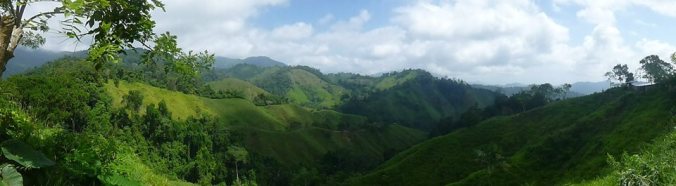
Colombia Rolling Hills

UnCivilized, 2013

On night two, I’ve fumbled my way out of my mosquito net. Rain pelted the tin roof structure where we would eat, sleep, and remain for the duration of the storm. I had heard a rumor of coffee in the “kitchen.” And after our day of hiking, I hobbled to a warm cup of comfort—careful not to let the rainforest’s rain find my already damp clothes. During the five-day trek to La Ciudad Perdida (The Lost City) in the Sierra Nevada de Santa Marta in Northern Colombia, clothes never really dry.

My hiking group—two Belgian girls, a guy from French Canada, a South American couple, and my boyfriend and I—had instantly bonded. Our “Magic Tours” tour guide, Miguel, had a great sense of humor and bag full of Colombian candy. We sat together that night discussing tomorrow’s hike into the Sierra. A dozen hiking groups surrounding us were doing the same.

After a few rounds of coffee and conversation a man appeared at the table behind our group. Surrounded by a small crowd, he spoke. All eyes locked on his face as he described his culture, a mystery to gringos. Miguel approached our table, pointed to the man, and told us in mumbled Spanish, “You’re next.”

We had seen many indigenous people over the past two days, passing them on the trail. We were told that most indigenous hated tourists and didn’t want us in the Sierra Nevada. Many gave us rigid glares, some returned smiles, and others stared at the ground. We met a small family at their hut that morning: a young mother and five cherubic, dust-covered children, one for each year she’d been married. A small girl followed us to a waterfall where we swam. She crouched on a rock hugging her knees, watching and smiling.

Minutes later the man sat down in our circle. His name was Fermin. A member of the Kogi tribe, he was chosen to learn Spanish by the Mamo, the tribe shaman. Most Kogis speak only the Kogi language. With only English, I was at the mercy of my new friends to hear his words second-hand.

Fermin wore his white tunic under a cascade of black silky hair. (The only indigenous people we had seen not wearing white tunics were children in extra large Led Zeppelin T-shirts.) His elbows rested evenly on the tabletop and his thick, calloused hands moved as he spoke. The strap of a saddlebag crossed his heart, its sacred contents rested next to his hip. His jaw was never idle. He chewed a cocoa leaf and lime combination like all Kogi men over eighteen. Following each sentence he took a breath and looked down, his lips meeting in a line over decaying teeth.

Candles propped in emptied tuna cans lighted the exhibit. Fermin said he would be telling us first about his culture. His tribe—one of four that descends from the original Tayrona people—rely on and protect the earth. The earth is the Kogis’ mother and they honor her with everything they do.

He explained the sacred poporo in his bag—a gourd filled with lime and cocoa leaves. Males, beginning at age eighteen, use it to bring them closer to “The Mother.” A foot-long stick through a hole in the middle of the gourd delivers the lime to the inside of Fermin’s cheek, so the reaction can take place. Sacred Cocaine.

I sat mesmerized by a man who had so little in common with me. “A walk that takes you thirty minutes, would take me five,” he joked. Surprised, we were happy to self-deprecate, laughing, loudly, with him.

He gathered his lips and switched to a somber face. Looking at each of us with black eyes, he told of the destruction and contamination caused by tourists and people from outside of the Sierra Nevada. The Spaniards had conquered his people in the sixteenth-century. His people have not forgotten.

Fermin worries about the Sierra and about the Earth. If “little brothers,” people not from Sierra Nevada, continue on our path of environmental destruction, the Mother will be in danger. A fellow-hiker named Paula translated tens of generations of wisdom. Fermin sounded as if he represented the Green Party.

“You should not go to Ciudad Perdida,” said Fermin.

We all stopped breathing. The point of our trek was to go to Ciudad Perdida, to see its ascending staircases, to behold the green-coated structures, to smell the air near the clouds. Not go?

Fermin looked at each of us and continued, “But when you do,” he said as we exhaled, “keep positive thoughts in your minds.”

He said the “Lost City” was never lost because his people knew it was there. Once a year, the Mamos go there to spiritually cleanse it. “From the dirty tourists,” I thought.

He wrapped up his talk, and I wished I could ask him a question. Instead, I said no fewer than four times, “Muchas gracias.” I wanted to apologize for the Spaniards, English-only Americans and all tourists, and tell him how this urban girl would go home and remember everything he said.

I appreciate nature and like camping, but I’ve lived my whole life between two Baltimore City neighborhoods. His life and my life could only intersect in this exact circumstance for these few moments. I wished he could know its significance for me.

Paula later told me that, in Spanish, Miguel contrasted us with the Kogis and other tribes by calling them “indigenous” and calling us “civilized.” She had purposely translated it differently for us, disagreeing with his word choice. They were indigenous. We were non-indigenous.

In Fermin’s presence, I felt uncivilized. Back in the States, the animated kids’ movie about talking beasts, “Monsters University,” dominated the box office. A New York mother of two had been released on $500,000 in bail after being arrested for warehousing millions of dollars of illegal drugs.

And now I was in the rainforest, feeling like a monster, speaking to an indigenous man who was openly, legally, and peaceably using coke.

The next day we woke, crawled out of our mosquito nets, put on our wet clothes, and kept walking toward Ciudad Perdida—armed with Fermin’s message, offering the positive thoughts he had requested. In his own words.

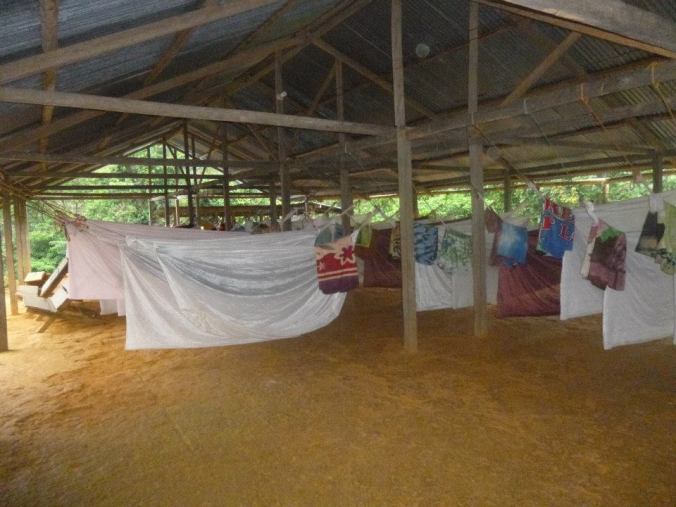
Colombia Accommodations

Our accommodations along the trek. Three nights were hammocks and one night was a creepy bed, much preferred the hammocks.

Colombia Layers

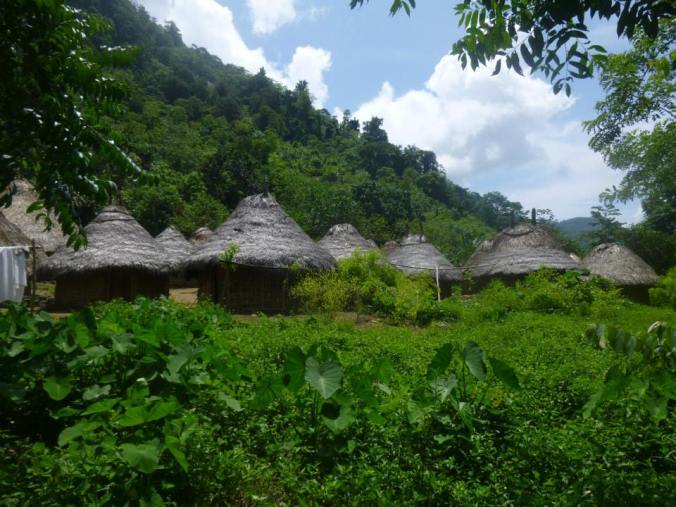
Colombia Village

Indigenous village.

ColombiaLostCity

La Ciudad Perdida

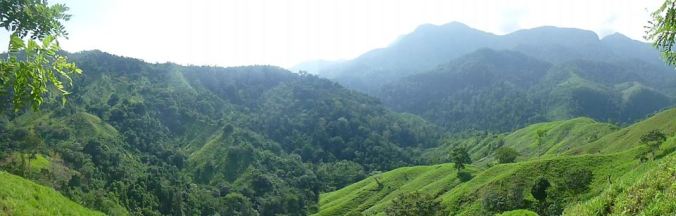
Colombia View

COlombia Lost City Entrance

At the base of the city.

Colombia Indigineous

Mother of four and her youngest.

Colombia FamilyColombia Child

Colombia Lost City

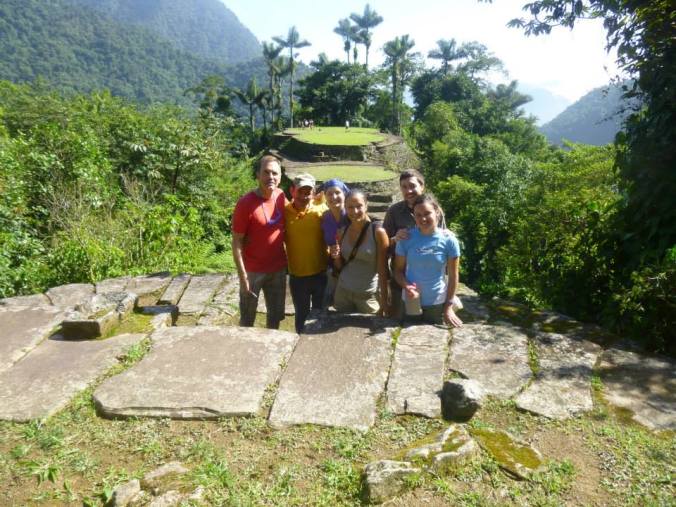
Our group in La Ciudad Perdida


Travel to Belgium (with a side dish of Amsterdam)

In Bruges is a strangely violent Colin Ferrell movie in which basically everyone dies. In it, Ferrell’s character who is as dislikable as any given Colin Ferrell character, constantly complains about Bruges. It’s ugly, it’s boring, it’s cold, people are miserable. I couldn’t disagree more. Chas and I chose to travel to Belgium after Greece because we wanted to keep traveling and wanted to visit a country we could fly home from affordably. That place turned out to be Belgium. Further proving that hired hit man, Colin Ferrell and I have nothing in common.

IMG_8454

Ghent

IMG_8478 2

        We arrived in Brussels and immediately hopped on a train to Ghent. It was only about a 30-minute journey to the central station in Ghent. The bus/tram system was navigable but we way overbought the tickets because we actually barely used it, opting to walk almost everywhere. We took a two-mile tram trip with our bags toward our hostel. The rep at the train station was really helpful but convinced us to buy a certain pass we didn’t really need so maybe not so helpful. We stayed at the Andromeda Ecohostel which we loved. It’s on a canal and located on an old barge. Our room wasn’t cheap but Ghent isn’t cheap. We had a private room, shared bathrooms. The couple that owns it is incredibly helpful and kind. Marten, the husband, greeted us, gave us a map and directed us where to go. Definitely get the locals maps. They’re really colorful and have a ton of great and unique suggestions. I don’t know what else to call them but if they’re not in your hotel, go to a hostel and ask for one. They’re free so no one will mind. We let this map guide us through Ghent to the point that it felt like linen when we were done and we had to hold our pieces next to one another to navigate from neighborhood to neighborhood.

IMG_8519

Our boat hostel.

        The first night we wandered around, went to a coffee shop and got our bearings. Definitely get water in a Dagwinkel rather than ordering it in a restaurant. They charge an obscene amount for small quantities of water in restaurants. We lived entirely off of giant bottles. We walked around Ghent that first night, napped, and then grabbed beers which we drank in the square. We wandered around so long looking for the perfect place to eat that all the restaurants had closed. Finally we ate at a frite barge. It was pretty terrible. They fry meat, cheese, and meat again and put them on a bed of frites. Just pick something and stick with it. With a little perspective, I know now that Belgian food isn’t very good. There are many immigrant communities though that make amazing food from their countries: Syrian, Afghani, Iranian, and more. Just do this after you’ve had frites and mussels at least once. Any Belgian will gleefully tell you that French fries are not French. They’re Belgian. One of our hosts (albeit one of the strangest people I’ve ever met–more on her later) told us that American soldiers in World War II started eating frites, heard people speaking French and thought, “Oh we’re in France! These are French fries.” Really, they were in a French-speaking part of Belgium but as Americans are wont to do, we made up a lie and stuck with it.  

IMG_8455

        The next morning was a Monday which meant that the two museums we planned to go to were both closed. We ate at our hostel which had free breakfast and then went to Gravensteen Castle. It was a pretty neat tour with weaponry, the castle, medieval life, and some Ghent history. After Gravensteen we did some more wandering and ended up on the Ghent University campus. We visited an old socialist building which is now a concert hall and meeting place. Then, we went to the big part in the city and the botanical garden there which is gorgeous. We ate at a delicious vegetarian restaurant near the train station. Ghent is something like the vegetarian capital of Europe. They do it well! We walked through the red light district – eeks! That night we ate at a fancy restaurant which was pretty good. We got some beers, a waffle and watched the people. Ghent is gorgeous. At some point in this wandering, we could not find a public restroom. After miles of discomfort and peepee dances, I literally just had to pull down my pants in a park and go. But as Americans are wont to do… Anyway, nothing bad happened other than I solidified my place in the world as a working professional who also acts like a small child. 

IMG_8483 2

        The next morning we ate our free breakfast and headed to Dr. Huslain’s Museum which was a short walk from our boat hostel. Dr. Huslain was one of the pioneers in psychiatry. The museum is in an old mental hospital. I highly recommend it if you’re interested in psychology and the weird history. Some of the videos and photos of the treatment of the determined “insane” are absolutely unspeakable, shocking, haunting. But I guess Huslain was trying to make things better and that’s why he gets a museum. There were also some whacky art exhibits. We learned a ton about Huslain’s work and about the history of psychiatry around the world. We also learned a lot about the Christian Brothers—a little propaganda exhibit was snuck in there. I forget their connection but it was presented as positive. 

IMG_8530

At Dr. Huslain’s.

        We picked up our bags and headed to the STAM (Ghent City Museum). This was the most modern and impressive display I’ve ever seen. It was a great lesson in Ghent, Belgium, and European history. They had an interactive map on which visitors could change the year, the location, etc. It’s absolutely worth the visit and they have big lockers for storing luggage. You could easily be here for hours. We then went to the train station and grabbed a quick train to Bruges. It was about an hour-long journey.

IMG_8463 2

Castles and beer. Belgium.

Bruges

In Bruges we stayed in an adorable AirBnb. Loved it. It was a section of a woman’s house and just the cutest little Belgian room. Bruges, like Ghent, is not cheap. 

This town in simply gorgeous. Super walkable city. We went through neighborhoods, stood beneath windmills, visited a convenience store run by a man who goes by Apu (a character from The Simpsons), drank incredible beers, and just explored. I feel like we had the least direction in Bruges but it was for the best. Again, get the Locals Guide map here. One of my favorite things ever was a house that I wrote about in this blog. The house was just on a random street in Bruges. 

IMG_8573 2

IMG_8584

We had a beer in a bar that was in the basement of a church, recommended on the Locals Guide. The basement was so old that it predated even the church which had been built in the 16th century. The basement had been the storeroom for a shop they believed went back to the 12th century. The bartender there told us that Bruges was in such good shape and so well preserved compared to other European cities in the path of World War II because one of Hitler’s right-hand men just “liked” Bruges and told the Nazis not to bomb it. I trust that bartender so I won’t even look it up.

IMG_8489

There was a church (featured in In Bruges in the way that three or four people are shot in it) where some of Christ’s blood is allegedly held. Once they wanted a couple euro to see it, we hightailed it right out of there. At some point we happened upon a marijuana festival which I guess is Belgium’s way of attempting to answer the vigor created by the Netherlands. The park that bordered the street where we stayed was a gorgeous run, almost pinch-yourself gorgeous, with swans and flowers and lamplights, and strollers but people probably call them prams. We only stayed one night in Bruges but certainly made the most of it. We trained it to Amsterdam from there.

IMG_8501

Amsterdam

In Amsterdam we struggled immensely finding our Air Bnb but when we did were so pleasantly surprised. It was another houseboat but the family used their top level for rentals. Diegert, the host, was about as helpful as they come and greeted us with beers. We could hang out in the front yard and rented bikes right from the family. Instantly, in Amsterdam you can tell that bikes are king, over walkers, cars, hovercraft, everything. We found ourselves stumbling to get out of the way of bikers until we figured out the rules of the road. We walked to a food hall which was just like a Dutch version of R House or Mt. Vernon Marketplace but with like 300 bikes out front.

IMG_8616 2

We visited the Anne Frank House while there, a must do, but you also must book it ahead of time. One cannot simply show up. The tour includes an audio guide with direct quotes and explanations of different uses of parts of the annex. It’s an emotional and humbling tour. Again, like we do, we just walked aimlessly throughout the city then bickered about where to eat. The next day we braved the bikes and spent most of the day in Vondelpark. It was divine. I just love the Dutch way of life.

Again, we spent most of the time agenda-less but in such a good way. I think we got a good feel for how people live there and it seems like a good life.

Amsterdam to…

Brussels

Brussels was pretty immediately a bit of a let down compared to the other utopias we’d visited. First off, I booked a private apartment on Air Bnb but when we arrived, Sophie, our host, told us that we’d have a roommate. She said that she had made a mistake and that Gen (a Japanese guy) would be arriving soon. Gen’s room was only accessible through the apartment’s only bathroom (which had no toilet paper) making showers and #2s pretty strange. Sophie showed up several times throughout the stay and was nice I guess but just clueless about hosting human beings who are paying for a service. On our last day there, we ran into her on the street in the morning and she told us that she hadn’t yet gone to bed. She asked if she could come up to take a shower and I wanted to say, “Well you’ll have to check with Gen” but we just said sure. She and her man-friend hung out as we packed our things for an hour. Just not normal.

IMG_8548

I started our time in Brussels by taking a yoga class down the street which was pretty great. We did our wandering and just found it to be less than spectacular generally. We did come across a memorial for the recent terrorist attack and happened upon some type of preposterous parade. Then, as we sometimes do, we found ourselves self-spite-eating fast food.

IMG_8492 2

The next day we visited the parliament building, braved the outside of the urine-soaked library, and happened upon an incredible World War I photo display in a park–that I loved. Chas had found his one demand on a local map–the Cantillon Brewery, a family owned brewery that uses an ancient method of brewing that depends on the seasons. We took the tour, drank the brews, and learned the methods. Loved it. We found an immigrant neighborhood near the brewery where we had an incredible Syrian lunch. Then we closed out the trip near our (and Gen’s) apartment.

IMG_8644

I’d recommend Belgium to anyone and Colin Ferrell can go shit in his hat.

Travel to Iceland

This continues a series of travel blogs. I have shared this with others who have said this made it seem like we hated Iceland, but I really loved it! It was among the most peaceful places I have ever been, and likely will ever go.

April 12-April 19, 2017

Getting There and General Tips

  1. We flew WOW Air overnight from BWI on April 12–direct. WOW has a handful of hubs in the US and for whatever lucky reason, one of them is BWI! Woot! We arrived into the Reykjavik Airport around 5 a.m. The flight was easy but you will want to bring your own water as everything including water costs money on WOW. I would also pack snacks because the food in the Reykjavik airport is basically a $23 pizza or dried, packaged cod–this is also true for much of the country, unfortunately. 
  2. If you rent a car (which I HIGHLY recommend), don’t buy into any of their American-targeted bull about sand and wind insurance. Say no to all of it. We never felt like we were in jeopardy and we took that little car to literal mountaintops–and it was a stick. Sure, we challenged that little transmission, but we weren’t being bombarded by any sand or wind. Also, the car had heated seats and a heated steering wheel–sound superfluous but it was indispensable. 
  3. Pack everything you think you will need. Do not go to Iceland with the attitude of “We will get one when we get there,” it is way too expensive for that. Bring what you need. I shudder to think of the cost of a toothbrush.
  4. I would just pack all layers. Layers all day and good hiking socks. If you fly WOW on which you pay for bags, here’s a sneaky little tip. Chas and I each took a “handbag” which is just a backpack. We paid for one carry on and crammed everything into that. We also dressed like Joey from Friends on the plane.
  5. Stop at a grocery store to save money on breakfast and lunch. Icelandic food is not very good so why spend so much on it? Bonus with the picture of the pig seems to be the cheapest.
  6. On your way to your first stop, find a Vinbuden. There are a limited number and they are the state-owned liquor stores. They have very weird and very limited hours. You’ll want to do this as beer and wine, like everything else, is obscenely expensive.
  7. Our first host (American) told us not even to bother with Icelandic. It’s absurd and everyone speaks English. Usually I’m not about that life but Icelandic is no joke. I did use this page when necessary.IMG_7205

Exploration

We picked up our rental car from Budget and headed for Snori’s Pool. Please skip this completely. It’s stupid and not worth a single second. Skip anything involving Snori other than reading his story somewhere, and it’s everywhere. They really love Snori. 

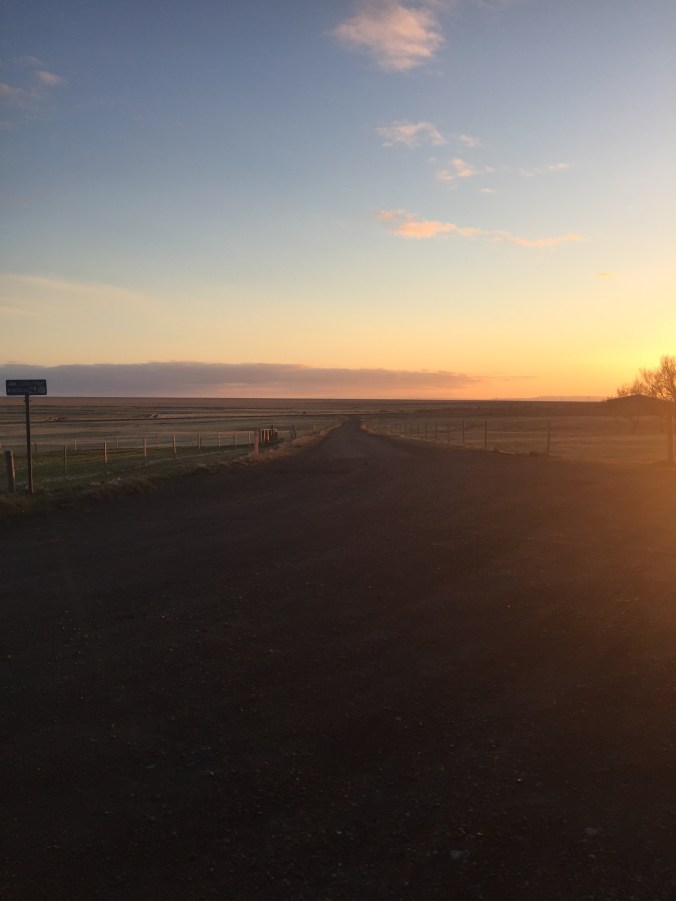
We stopped at a gas station in Akranes and got free coffee and a sandwich. Some gas stations have free coffee. Cute little town–not a ton going on. But, it seems like people wake up much later there. We were in the center of the town and maybe saw two people, aside from the gas station worker. 

We hit the road for Borganes. We putzed around the town, stopped in the museum shop, we did not pay for the museum. We are happy we skipped it as it was expensive and other things seem more worth your money. Borgarnes has some historical significance and a really neat little coastline. There’s a legend that allegedly took place right here…something about an eagle and man…I don’t know…read the plaque…I was too jet-lagged. 

We went to our bed and breakfast called Borganes B&B. The owners were adorable and I instantly loved the house and felt snuggled. They had robes for us to take to the hot springs and a great guide to hot springs in the area. The owner (husband, American) told us that if we were looking how to spend the afternoon, we should go to the Sportlaug which is their term for a sports and community center. It was $8, indoor pools and outdoor pools, hot tubs, water slides. This is how Icelanders spend their free time! It was neat to see. They had three different temperatures of hot tubs. The water slide water was cold AF but it was a “When in Iceland…” situation so we took several rides, then found respite in the hot tubs of varying temperatures. There was a steam room in the bathroom for the end of the workout. 

We ate at the Thai Restaurant–good food, best deal in town. Back at the place we met a Swedish couple we sat and talked to for maybe two hours. The B&B had a huge bay window in the living room through which we could see every star that ever existed while we chatted about education and politics in Sweden vs. the US. Then we bid them goodnight and slept the best sleep ever.

We woke up, ate our breakfast from the grocery store and hit the road for the Snaefellnes Peninsula. Amazing. There are so many places to stop along this drive. There’s also basically only this one road so it’s easy to navigate–honestly, you don’t really even need to navigate. The stops are otherworldly, but so is the drive itself. 

Along this drive we:

    1. stopped at a mountain and did a little climbing and viewing. We could see the water from the vantage point. Although it was freezing, it was gorgeous. 
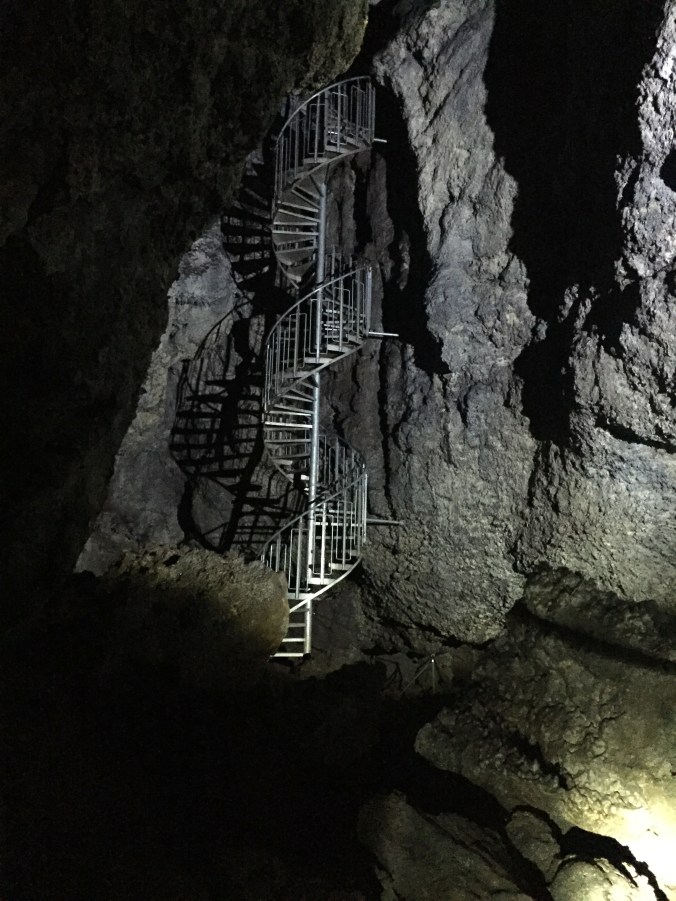
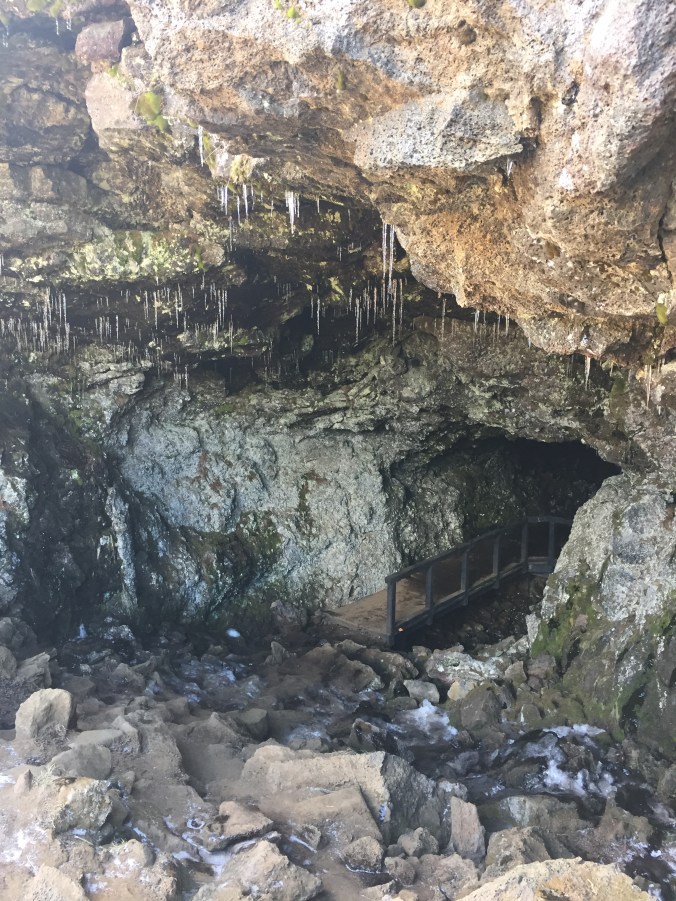
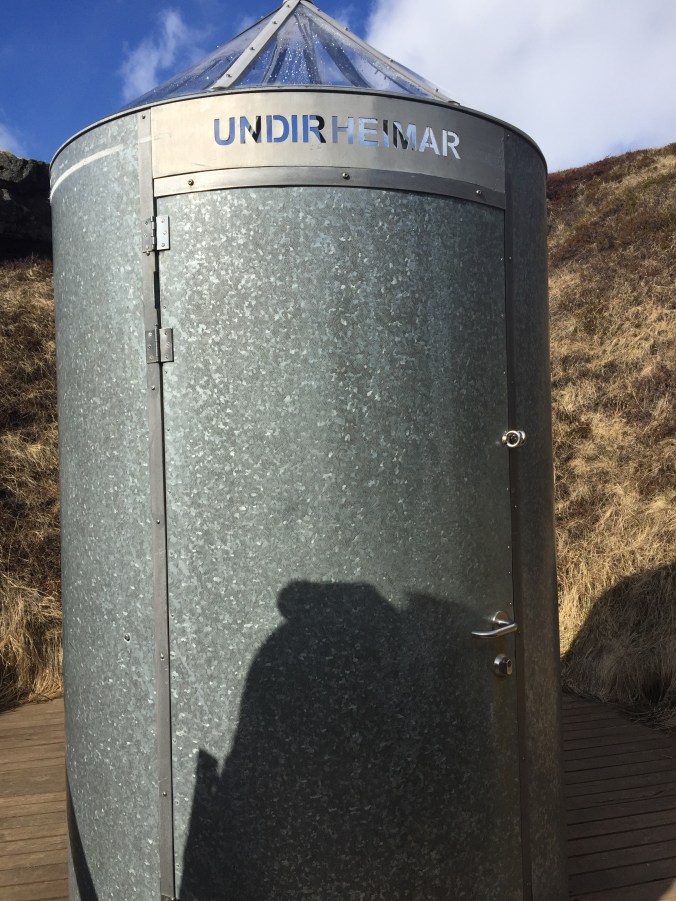
    2. went to the Vatnshelllier Cave. Totally worth it. Maybe around $20? Cool tour, 45 minutes. We learned a lot about the volcanic nature of the island. Vatnshellier is a lava tube created by a volcanic eruption. When the lava receded or dried or does whatever lava does, an empty space was left. We had headlamps and were able to walk along the inside of the tube. 
      IMG_7180

      Steps inside Vatnshellier.

       IMG_7185

      IMG_7184

      Tube down to the Lava Tube. 

    3. climbed to the top of a crater along the road–can’t remember the name. There were actual steps on the crater to get to the top. From the top, just desolation…but in a good way, I think. Iceland Scene
    4. walked into a canyon, also just along the road. The canyon contained rushing water and some were climbing inside of it (and coming out with soaked/frozen feet). The climbing was a little challenging because of how slippery it was but we saw some incredibly epic falls (not waterfalls, people falls). 
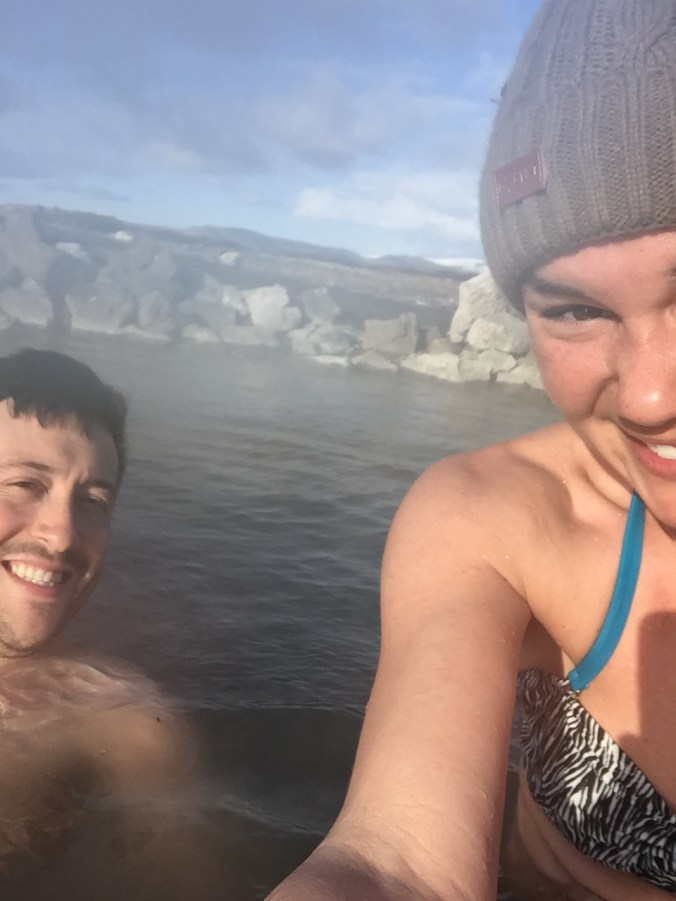
    5. took a long soak in Landbrotalaug Hot Spring in the middle of an abandoned farm. For sure do this one or one similar. Here’s the obscure book where we found it. Another great thing about this natural spring is that you could choose your temperature. Closer to the flow was hotter and farther away cooled off. Our B&B allowed us to borrow the robes from the room which was really helpful. You’re basically changing into your bathing suit in the middle of a field at 30 degrees Fahrenheit so a robe is useful. Most Icelanders just do this openly and in the buff so don’t be shocked to see some butt cheeks. 
  1. LandbrotalaugIMG_71986. stopped at other random things along the way–just let our hearts guide us. All cool. 

IMG_7453

The next day we drove to Hof. It is a town, population 20.

IMG_7314

The “town” of Hof.

IMG_7311 (1)

All of the people who’ve ever died in Hof.

We stayed at the Hof Hotel. It was good enough for us! Barebones. I do not recommend eating here though. The breakfast was free but get dinner at the gas station about 15 minutes west on THE ROAD. We stayed in our little cabin for two nights. It was basically just a box among a few other boxes, next to a cliff, in the middle of a field. The Hof Hotel did have a jacuzzi and men’s and women’s saunas. BUT the first night we bought dinner which was cream of asparagus soup and bread…$21. It was more or less a bowl of butter and cream with a lone asparagus stalk…for $21. The next night, we ate this…IMG_7370 (1)

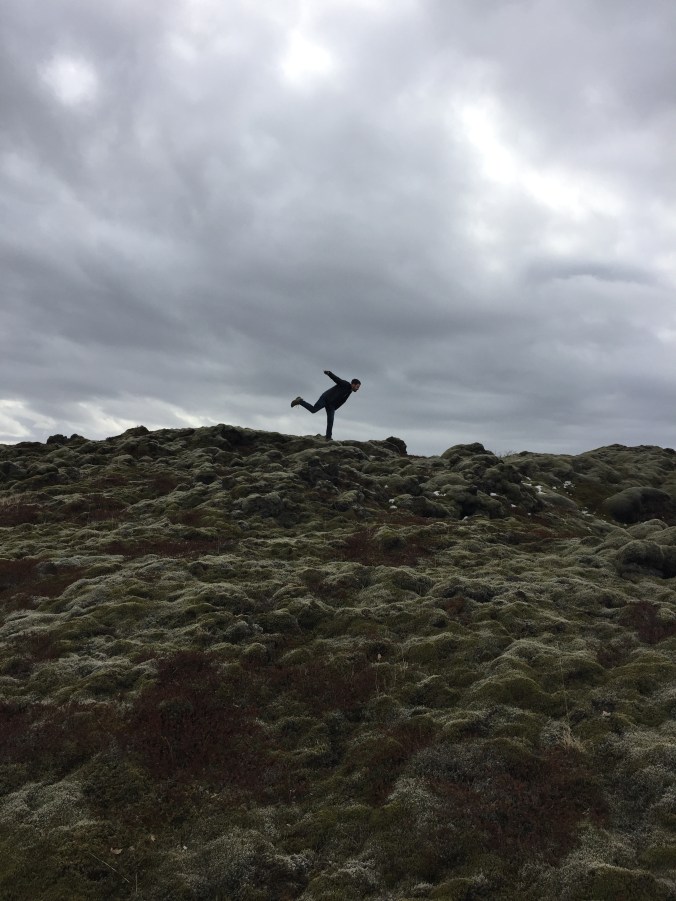
The drive to Hof was gorgeous and various and it was an adventure in its own right. We just stopped whenever we felt like it. So isolated and beautiful and strange. The landscape changed every few miles from rock to moss to rock to ice to snow to water to mountains and back again. We also listened to S Town on this drive which kept us super occupied. 

IMG_7238

Chas doing “Kev’s Bird” in moss.

Just before checking into the hotel, we went to the Skaftafell National Park and did a few hikes. Very cool. Go to the little abandon mountainside town and hike to the edge of the glacier (only a 2 mile round trip). We also hiked (easy) to the Svartifoss Waterfall.

IMG_7298

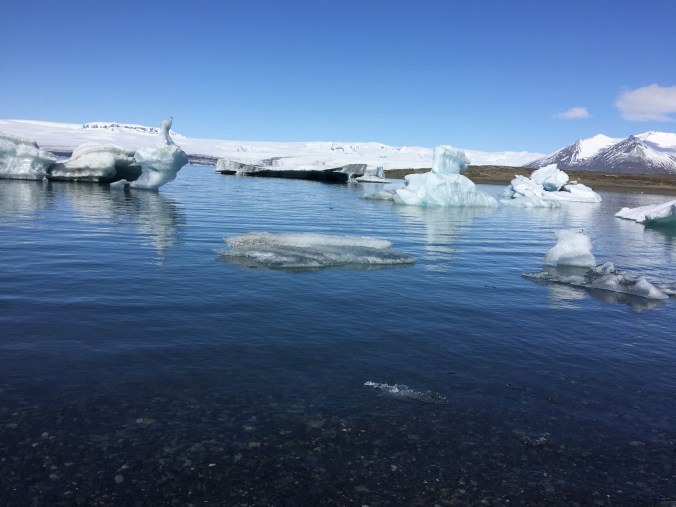
From Hof, we visited the Jokulsarlon Glacier and its glacier lagoon. This was incredible. We saw maybe 60 seals here.IMG_7351

We started hiking around the perimeter but it is deceitfully large and it would have taken all day to go around the entire glacier so we did about a 3 hour round trip walk. Definitely go here and watched the seals. They’re basically just fat + faces. We ate at the gas station beyond Hof. Better than food at Hof Hotel for sure. Again, we stayed at Hof Hotel. We explored the little churchyard and graveyard a little bit, I think it was Easter. Chas woke up four-five times in the night to try to see the Northern lights but we never did.

IMG_7336

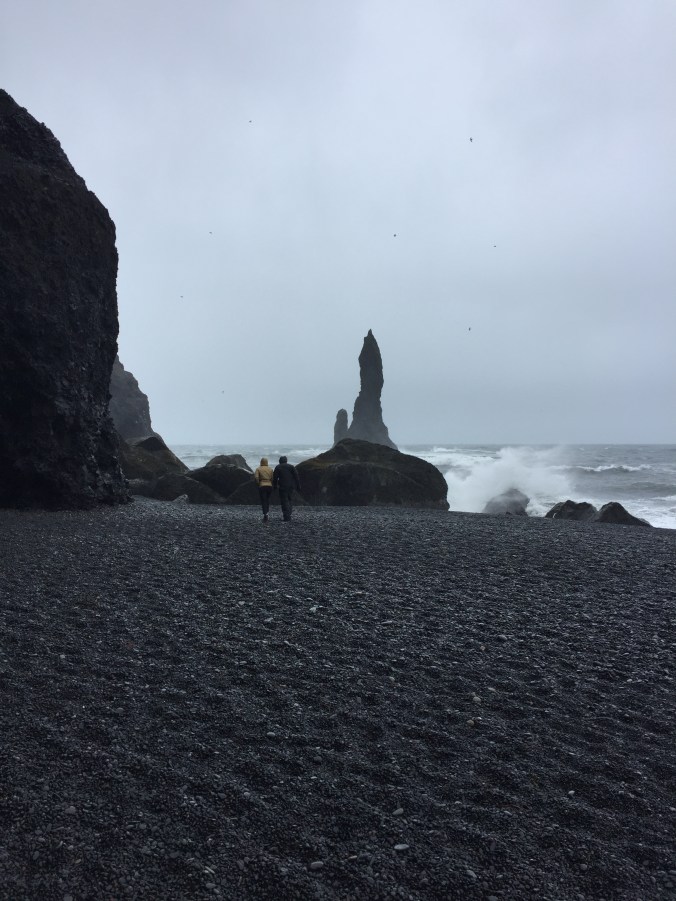
The next day we ate the breakfast and left Hof to head back west. We drove to Vik, a tiny little town. We stayed just east of Vik in a fine hotel. It had a huge outdoor hot tub where we got wrinkly with some Americans for a good hour of chat. In Vik we explored the beach but the weather SUCKED. We went to the top of many things while driving west of Vik. I have never experienced wind like this. By the end of the day we were soaked and freezing. We stopped at the Black Sand Beach and did each climb and drive in this area. We spent a lot of energy looking for puffins–no dice. If it’s late April and beyond you can see puffins along this coast. Vik is cute and an interesting look at Icelandic life. We ate at the gas station in Vik. It has a cafe in the back. Don’t get the Icelandic stew–not worth it.

IMG_7408

Black Sand Beach. Cold and windy AF. 

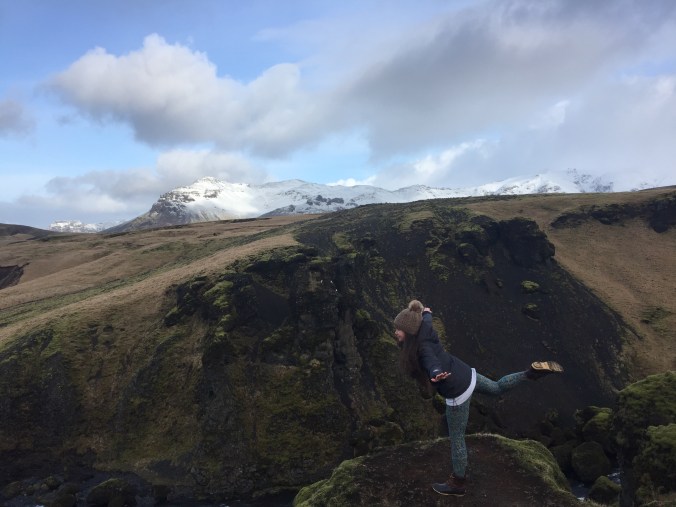
First stop the next day was Skogafoss. It’s an incredible waterfall that doesn’t look that impressive from the road. Go here. Go to the top of the waterfall and then hike back at least for 30 minutes. It’s amazing up there–more views, waterfalls, and unusual beauty. It looks like Lord of the Rings scenery–maybe it is?


IMG_7435

Above Skagafoss.

We stopped to see some horses! IMG_7453

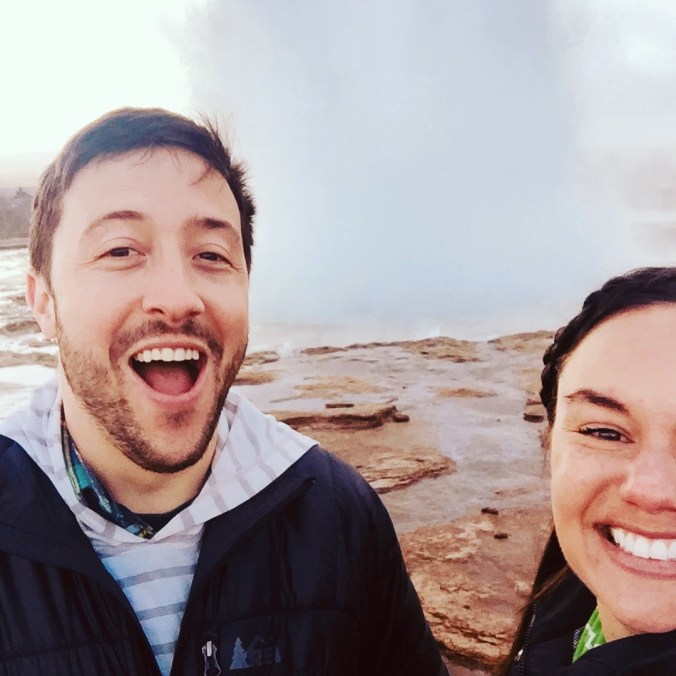
From Vik the next morning, we drove to Geysir National Park. This is a must do. It’s why a geysir is called a geysir. Like a Kleenex, they called this Geysir and then the word became a common noun. The eruptions are frequent and surprising.

IMG_0087

There’s a bourgeois food hall there and fancy shopping thing. Also a bathroom. Driving here was a little confusing for us–make sure to figure out ahead of time.

We made car sandwiches and then went to Pingvellir National Park. Another must do. Lots of history here. You can read all about it in the guidebooks. Also, it’s pronounced TINGvellir. This was one of my absolute favorite sites to explore. Here you can see a spot where the earth’s crest is literally splitting–kind of a bummer but the park is gorgeous. I would have LOVED to have camped here for a night or two. 

We then drove to Reykjavik. We stayed at the Reykjavik Downtown HI Hostel. I liked it there. They had a guest kitchen which was a good way for us to eat our hikers’ breakfast the next morning.

We explored Reykjavik that night. It’s meh. Not my favorite city. IMG_7536

We did eat an incredible seafood meal and just shelled out the money for it. We stopped at a few neat off-the-beaten-path bars. There actually are a couple of really cool ones. I would say a lot of Reykjavik felt tourist-targeted but look a little closer, walk a little longer. You won’t necessarily pay less but you can avoid the kitchiness. We also went to the Lebowski Bar because Chas loves Lebowski–it was kind of stupid though and I have no idea why it’s in Iceland. 

The next day we walked around Reykjavik, ate hot dogs, and visited one more Bonus Pig, until it was time to head to the airport. Again, pack food. 

I think one thing that is a tiny bit frustrating (aside from the cost when you arrive) about Iceland is that there’s no perfect time to go. All times of year have their benefits and you just have to choose what’s important to you.

Things we wish we could have done:

  1. Seen puffins. (late spring/summer only)
  2. More seals. Infinite amounts of seals.
  3. A ice cave tour (winter only)
  4. A glacier lagoon boat ride (late spring/summer only)
  5. Driven to the West Fjords
  6. More hot springs–not Blue Lagoon
  7. Seen the Northern Lights, trust me, we tried!

IMG_7278


Travel to Greece

In June 2017 Chas and I had the absolute joy of attending Kevin and Angeliki’s wedding inside and outside of Heraklion on the island of Crete, Greece. Not only are Chas’s friends from college among my favorite people on the planet, we had a reason to go to Greece. I had been to Athens for a weekend and a smattering of islands on a day trip in college. During that weekend, Mary and I stayed in a dicey red light district hostel and someone stole my wallet. That was not how it was supposed to be according to The Sisterhood of the Traveling Pants (books and films). Kev and Liki’s wedding was a chance to right that.

Here’s that trip.

IMG_8206

Crete:

We flew into Heraklion using Jet2 which was a budget airline that flew there for reasonable prices. I can no longer find Jet2’s website which indicates to me that it may no longer exist. Kind of a bummer but there must be other ways to get to Crete. We flew through Reykjavik, Iceland then Manchester, England then onto Heraklion. Not a short journey but…

IMG_8125

We stayed outside of Agia Pelagia which was about 30 minutes away from the airport, and extraordinarily fun to say aloud. We stayed in this villa which overlooked the Aegean Sea. The villa was huge (there were about a thousand of us) but I am sure there are smaller options with similar accommodations. A few groups we were with rented cars. That seemed to be maybe the best thing to do.

IMG_8193

The Heraklion airport is kind of a mess but it’s fine. You can take a short cab into Heraklion or take a longer ride to one of the nearby villages. You can drive down to the town of Agia Pelagia and visit the beach and the town cats. There are plenty of grocery stores around down there to load up on everything you need up top, which frankly, is everything. The rental car places allow you to park in their lots while you are in the town–quite useful. We only went to the town once, because honestly, we were our own town within our villa, but it was a cute little place and then it was nice to go back up top and leave it behind.

IMG_8205

There was also a bus to travel down to Heraklion from Agia Pelagia which I remember being reasonably priced and more like a charter bus situation than regular public bus. This was helpful for us because we were rolling so deep and cabs were long and pricey.

Goats scale the cliffs–you just have to look closely.

Heraklion is pretty cool. It has a European feel including all the drinking, eating, and grunginess. It’s actually a decently big city but the center of it is manageable on foot and the surrounding areas aren’t necessarily something one would want to visit (from what I saw). The harbor has a fort and some ancient sites. We didn’t see them because we spent so little time in Heraklion but they were a neat backdrop and I am certain, historically valuable, etc.

IMG_8075

You cannot drink the water in Crete and we just didn’t drink it in any of the Greek islands out of caution. Big bottles are reasonably priced. I’d recommend just buying a 6 pack of 2 liters and carrying them around. Apparently, the tap water is safe for our systems but tastes salty because of their de-salination process. It also contains more minerals than we are accustomed to so it could bother a gringo tummy. 

Aegean Sea:

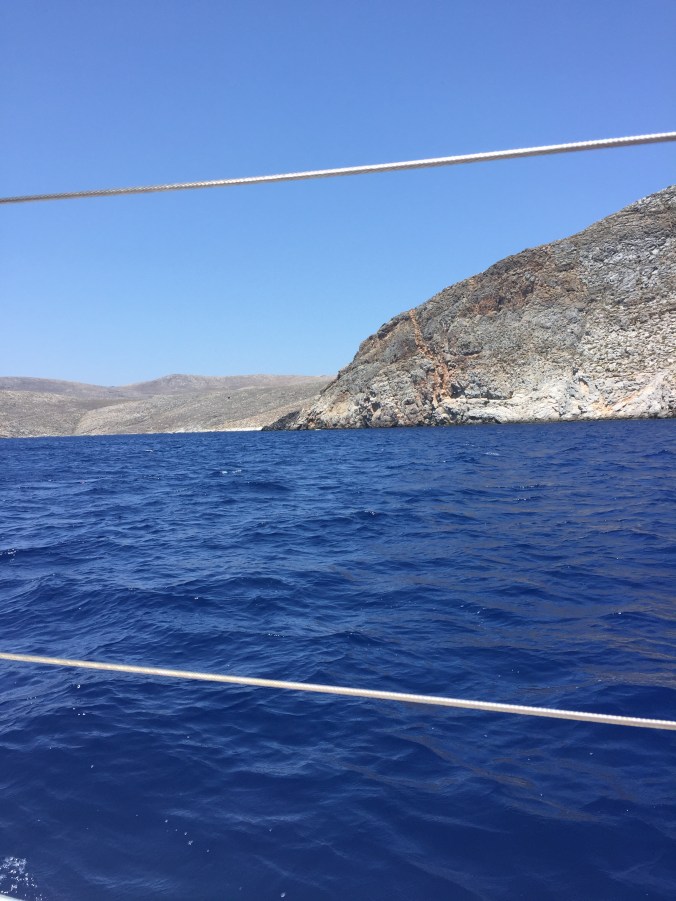
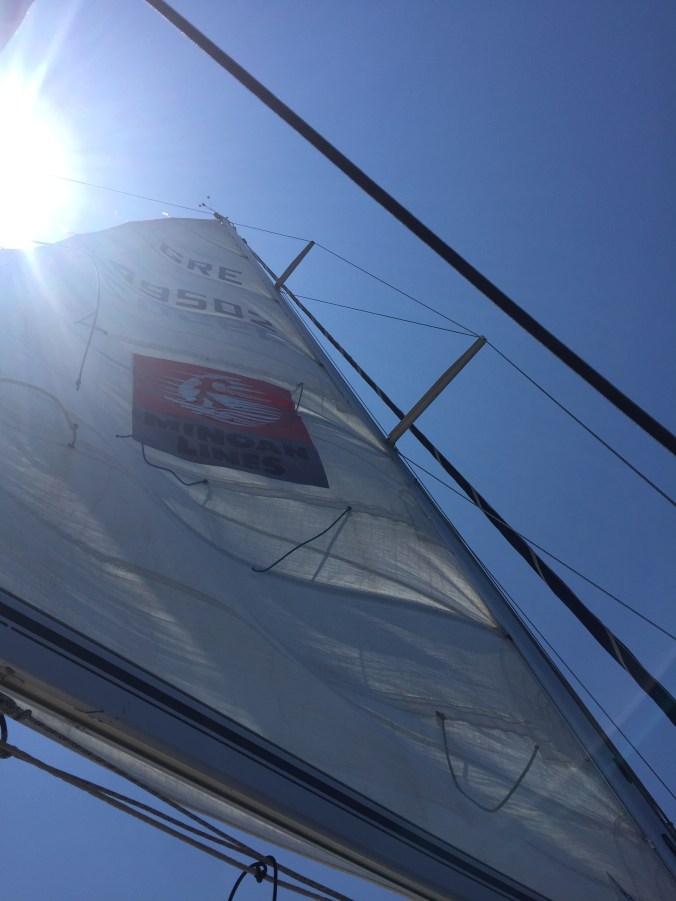
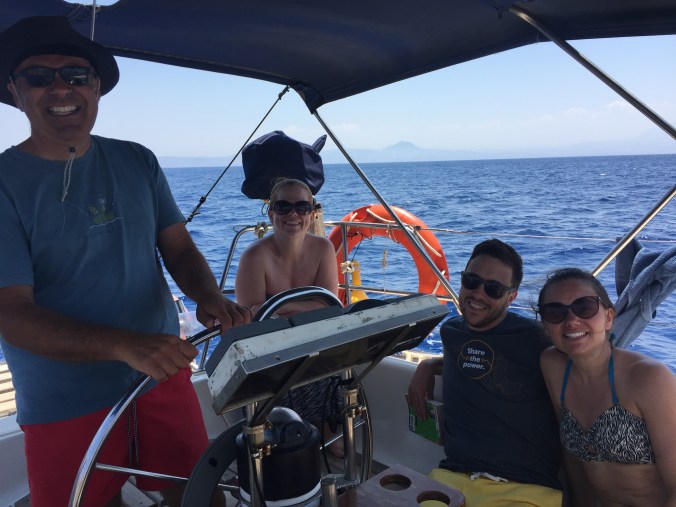
From the harbor in Heraklion, we took a two-night sail on a chartered boat with Greg, Beth, and a captain. It included all meals and really just cost as much as a “normal people” hotel would have. There are plenty of charter boat situations in the harbor in Heraklion. The idea is that you participate in the sailing. Our skipper Jiannis taught us different aspects of sailing and included us in the process. (Most were very gender specific and assumptive in terms of what a woman can/cannot do.)  Jiannis also prepared our meals with foods he had brought on board. We had fresh fish, Greek salads, oregano from the island we visited, yogurt and fruit, and just beautiful Greek foods. Also wine. 

IMG_8159

We sailed into the Aegean Sea and around the island of Dia. Dia is covered in oregano plants and is completely uninhabited by humans. There are thousands of seagulls who are constantly making noise. Such a unique thing. It’s like a sensory bombardment in the middle of the sea where there are zero other people.

IMG_8162

We stayed a night docked off the coast of Dia. This was a gorgeous experience in terms of stars, solitude, sounds. We walked around Dia during the day, went to the abandoned tavern, the church. We got to swim, relax on the boat. We spent the second night sleeping in the harbor in Heraklion. We were able to walk around Heraklion. The boat that night was really hot and I found it difficult to sleep. That said, I took 4 naps that day and I might have had a hard time sleeping because of that. I would think you could take a cruise like this from many of the islands and I would recommend it. These were among the most peaceful days of my life. It was cleansing, relaxing, and just really special.

This is essentially what we did but I can’t remember the company. The organizer was great and very responsive. His name is Nicos. Our skipper was Jiannis and we loved him. 

IMG_8181

We woke up the next morning in the harbor and took the ferry to Santorini. The ferry is within walking distance of the spot where we docked the boat. I was extremely impressed with the timeliness and reliability of the Greek ferries. Way to go, Greece!

The ferry between Heraklion and Santorini wasn’t cheap but it was very comfortable. If you have the choice I would take Hellenic Seaways. It’s the same price as the rest but it was much better than Blue Star. It was only a little over an hour.

Santorini:

IMG_8267

Santorini is stupidly gorgeous immediately from the time you arrive. It is an island created by the remnants of a volcanic caldera. You can see this imprint, in a way, from above. 

IMG_8225

Do not take a cab or private bus company from the port. Walk a little to the left of the boat and grab the public bus. It’s really nice and about 2.50 euro. It will take you to the top and variety of towns. We stayed in Imerovigli. It was after Fera which was the main bus hub at the top. Weirdly, the port down low is also called Fera or sometimes Thera. This is confusing but they seem to have it under control.

IMG_8224

If you stay in Imerovigli you take the bus to Fera and then transfer to a bus in Imerovigli. I would highly recommend Imerovigli. It’s absolutely gorgeous and well-positioned for the view, height, walkability to everything you want to see, visit, purchase on that side of the island, etc. We stayed in this stupidly fantastic Air BnB and loved it. It was one of those houses that’s been carved into the volcanic rock which helps with climate control. Our patio which lead out from our bright blue doors was next level. We didn’t eat out, just got the amazing provisions from the grocery store and sat on the patio where we could see the view of the volcanic harbor. From what we understood restaurants could be pretty expensive. We just loved the cheeses, breads, olives, and spreads so much that the grocery store was perfect for us.

IMG_8243

There’s an urban “hike” from Imerovigli to Fera which you should do. You can see everything including the town. It’s touristy in most parts but so breathtaking. That night we went to Oia (pronounced Ia) to see the sunset. It’s crowded but it’s supposed to be one of the most beautiful sunsets in the world. I’d concur. You can take the bus to and from Oia to Imerovigli. It’s cheap too. I’d go a little early because from the bus stop there’s some confusing navigation to get to the top of Oia to see the sunset and a trillion tourists.

IMG_8250IMG_8259IMG_8271

Naxos:

From Santorini, we took another Hellenic Seaways ferry to Naxos. This was a little longer—maybe 3 hours? Our hotel (Chas found it on Hostelworld) was ideal for us. It was the Korali Garden Hotel. The owner, George, picked us up for free from the port. He wouldn’t even accept a tip. It was really cheap per night (around 30 euro) but had everything we needed and George was like the best human. We had about a 1 km walk to the center of the town from Korali Garden. We ate that night at Maro which was awesome and so reasonable. Try the grilled octopus and moussaka. A liter of house wine in a metal pitcher is around 6 euro.

IMG_8334

Also walk to the Temple of Apollo. We missed the main museum because it was closed already but heard it is cool. The center of town where the museum is located is remarkably confusing. But, if you’re not pressed for time, just wander it and get lost. It’s gorgeous. Also, gelato.

IMG_8349

The next day, George called a rental car company for us and we rented a car for 30 euro for the day–this felt really reasonable. It was a stick so make sure you ask if you can’t drive stick. The car was perfectly shitty. We drove around the center, saw the Kouros which are massive ancient sculptures of human bodies, and walked some of the ancient paths. Chas really loved the marble mines which you can very clearly see. We took some marble with us as well–don’t tell customs.

IMG_8296

We also visited to a town in the center of the island, called Apiranthos, and walked around during the day. I really liked this. I bought stamps at their “post office” which was just two old ladies in a living room who spoke no English. The streets which are entirely made of white marble are super confusing, but in a good way. We wandered the streets, got lost, it’s just a very different life and I think this was the perfect town in which to see that. There were goats and a raised cemetery and just an entire life that exists here in the very center of this Greek island.

IMG_8354

After driving around the center, we drove to a few beaches and relaxed. You can have your pick of beaches. (The beach in Naxos Town is pretty lame, very shallow water and crowded so renting the car was a good idea if only to see the other beaches.) It’s really pretty small so you can drive the whole island in a day. Chas burned the soles of his feet on one beach. Beware! 

Toplessness and total nudity are all over these less dense beaches. If you need an escape from the sun, be prepared to pay for an umbrella.

IMG_8322

Naxos is an incredibly diverse island. They do have buses that take the same trips with similar stops that we made but it was great to have control with the car. One party-party-looking beach town where we had a drink was Agia Anna. It looked like a fun enough place to stay but maybe not for more than a night or two. Another one (can’t recall the name but it might have been Mikri Vigla) didn’t have much going on, but not in a good way, in my opinion. The beach was absolutely gorgeous but the surroundings in terms of amenities were a snooze, and not necessarily in a charming way. Just research your beaches first before choosing. The second night we ate at Kastro which was a neat place. The table was on a patio with an excellent view. The whole dorado was great, as was our lamb meal—some type of pot that they cook in the oven along with the food. I’d definitely recommend Kastro. This is also the night we visited the fish spa and did a 15 minute foot treatment—neat thing to do just once.

Athens:

The next morning George took us for free again to the port. We had a ferry to Athens booked on Blue Star. Wifi costs and there are far less seats than Hellenic. Since it was a 5-hour ferry, you actually want some comfort. Upon arriving in Athens, there was immediate chaos.

IMG_8393

You should know that I hate Athens and I know it’s not fair. We found our way to the subway and almost immediately, there was a guy trying to pickpocket. Keep your eyes peeled, for sure. We took one of their 3 subway lines to our hostel and wandered around until we found it. The Acropolis was closed because it was 108 degrees Fahrenheit. I was really glad I’d already been because it is an incredible historic site, but I was sad that Chas didn’t get to wander it. We had to settle for seeing the Acrop from a distance and spending our time in the air conditioned museum which is pretty impressive and was not there at all the first time I went. Budget some time for it for sure. It is also air conditioned AF which was a necessity considering the temperature outside.

IMG_8399

We then met some friends for dinner which was fun and got the hell out of there in the morning. We flew from Athens to Brussels early the next day. We flew Aegean Air which surprisingly fed us. Their lines are a pain in the ass though so I’d recommend getting to the airport earlier than usual. They’re kind in the customer service sort of way but extremely inefficient.

General Information:

I was pleasantly surprised by how “together” Greece was. The last time I went there I perceived it as a mess. And, from what you hear in the news, it seems like it’d be struggling in terms of timeliness, reliability, etc. I know they’re struggling financially. Anyway, aside from Athens being the worst place ever, everything was on time. Everyone was friendly and helpful. We walked away with an incredible impression of the islands. It seems like Greece knows that its tourism is its bread and butter and it’s got its head on straight. In addition, prices seemed reliable everywhere and I never felt duped. I’m happy for Greece! The ferries are a really incredible way of getting around–can’t say that enough.

Giasou – hello

Kalimera – good morning

Kalispera – good afternoon

And that’s the limit of my Greek!

This is Chas’s Google sheet that guided the more logistical parts of our trip. (It’s also a great example of differently our brains work.)

In sum, go to Greece.

Travel to Italy

For these next few installments, I am thinking of presenting trip notes for different places Chas and I have loved. These are notes compiled over the course of 8 years, about traveling to Italy. If you have thoughts to add or amend, please comment! This is obviously extremely incomplete and just my opinion. But Italy is my favorite. Hands down. In case you can’t tell from this, you should go there (even if you’ve already been, go back).

Shout out to my Rome roommates: Deb, Chelsea, and Lauren, who remain my friends to this day.

IMG_3064

Chas and Kev in Siracusa after a boat trip with a guide named Cico (chee-cho). 

Italy

    1. Basic Italian Terms for Right off the Plane
      1. Italians just appreciate that you’re TRYING to use Italian. Always greet in Italian and then you can ask, “Parla Inglese?” (Do you speak English?)
      2. Buongiorno – Good day/morning
      3. Buenasera – Good evening
      4. Arrivederci – Goodbye
      5. Ciao – informal hi/bye
      6. Prego – You’re welcome/ Can I help you?/Go ahead
      7. Grazie – Thank you
      8. Grazie Mille – Thank you very much
      9. Vorrei – May I have/I would like
      10. “Ci” = ch sound
      11. “Zz” = ts sound
      12. “Ch” = k sound
      13. “Ll” is NOT y like in Spanish
    2. Food
      1. My first advice is to eat everything. The food their is SO fantastic and of such great quality, even the shadiest looking place, you can’t go wrong.
      2. If somewhere feels touristy, IT IS. Run. As in any place, try to eat off the beaten path. You’ll pay less and get better quality. You CAN find this in Trastevere, just walk away from the major attractions.
      3. Get gelato EVERYDAY. It’s SO much better than it is here. Also, the seafood is incredible. Eat things you can’t pronounce. Try squid ink risotto (it’s black!).
      4. Know that water and bread will be offered for a price. Tip should be 1.50-2 euro. In Italy “euros” is NOT a word. It’s just euro like “three deer,” “three euro.”
      5. Try the tiramisu – I couldn’t believe their tiramisu.
      6. Go into a small vegetable and fruit stand and get blood oranges. Their produce is SO good and they have some cool stuff we don’t so take advantage. Definitely go for the blood oranges.
      7. Meals to Italians last like 3 hours. Don’t expect your waiter to be fast. They think you want to enjoy your food and when you’re in Italy…you do. Just be relaxed about it. You’ll enjoy the meals more if you’re low stress and you take it slow.
    3. Transit in Rome (and much of Italy)
      1. I used public transit all the time. You can use cabs but they will know you’re tourists and they will take advantage. Years ago, 75 minutes on any transit was 1 or 2 euro. You buy the tickets in Tabbachi shops which are everywhere and marked with black signs with “T” on them. You stamp the ticket when you get on and it’s good for 75 minutes on any type of transit: bus, tram, metro.
      2. The metros are GHETTO but the bus and tram are great. The tram basically cuts Trastevere in half and you’ll spend a lot of time in that neighborhood for sure. Use this website: http://atac.roma.it/ before you go somewhere in Roma. You can map out a route and you can do it in English.
  • Rome IMG_2790

    Inside St. Peter’s Basilica.

      1. You will probably want to stay in Trastevere. We used Air BnB when we went back most recently and it was super cool. Loved it. Place was fine. Street was magical. Very classic. Trastevere is the best mix of amazing attractions and in some parts, actual Roman experiences.
      2. My favorite attraction is the Trevi Fountain for sure.
      3. I would suggest though going into ANY church. They’re all old and they’re all beautiful.
      4. The Spanish Steps, I think, are best right around sunset, so magical.
      5. Behind the Spanish Steps there is a giant gorgeous park–see below re: Villa Borghese.
      6. The Keats and Shelley Museum as on the right at the bottom. I don’t know how much you like classic British Literature but I loved that museum.
      7. There’s also a great Spanish Steps Pub Crawl but I think I am remembering it as “great” in a rosy retrospection kind of way. Let’s just say, I did it more than once and one of those times, I may or may not have pulled my pants down and peed on the street.
      8. Definitely cross the bridges. They ALL have stories and so much history. One is called the Ponte Sisto (ponte means bridge) and it was built on the taxes citizens paid on prostitutes in like the 1600s.
      9. Over one bridge you’ll find the Castel di San Angelo. I don’t know if it’s necessary to go inside–I never did–but it’s a gorgeous building from the outside.
      10. When you go to the Vatican if your trip doesn’t include the Catacombs – GO! I don’t know what it is I’m not that religious but when I saw the grave of JP II I immediately started crying. It was very touching and there are a million dead popes there. Inside St. Peters, make sure you look to the right immediately when you walk in to see the Pieta. It’s like the most famous statue in the world. It’s okay I guess :). BOOK YOUR TICKETS ahead of time BUT do NOT use the touts outside of the Vatican. They’re full of shit. You’ll wait and that’s okay. The Cistene Chapel and everything leading up to it are worth it. Don’t talk yourself out because of a line.
      11. This is the kind of thing that’s off the beaten but very worth doing: Near my old apartment there is a walk that allows you to see the entire city. It’s a fantastic vantage point. It’s just outside of Trastevere (the neighborhood where most of the touristy stuff is). It’s probably technically in Monteverde (my neighborhood). It’s called the Gianicolo (Janiculum in English). There are like 7 major hills in Rome and that’s maybe one of them. Along this walk, you’ll see a lot of statues of heads (really, really old) haha but it really is SO cool and the view is AWESOME. It’s the kind of view of a city you’d see on 60 Minutes or something.
      12. There’s a really amazing art museum called the Borghese. It’s in the center of a park called the Villa Borghese. This was an old family that owned everything. There are a LOT of cool public parks in Rome. I heard it was because wives weren’t allowed to walk the streets so husbands (with money) had to buy huge plots of land so that their wives could walk on the family’s property instead of in the street. Of all of these types of parks that I saw, my favorite was the Villa Borghese. It’s HUGE and gorgeous. This will definitely be reachable by public transit. My second favorite was right down the street from my apartment called Pamphili. I used to run there a lot and it’s a great place to see real Roman life. Near the Borghese is the Museum of Modern Art which I had to go to for a class. It was pretty amazing but my suggestion is to choose ONE museum in Rome to see and appreciate. This way, you’re doing as the Romans do and you’re not spending all of your time in museums. Just pick allegiance to one.
      13. When you go to the Colosseum, get your tickets at the Roman Forum and do that first. The line at the Col is long but the ticket from the Forum is not and the ticket is good for both.
      14. There are two airports in Rome.
        1. Fiumacino/Leonardo daVinci is the larger one with international flights and actual runways.
        2. Ciampino is the smaller one. This is where Ryan Air flies out. It’s “fine” but literally nothing extra. I don’t love it but it’s a necessary evil for some flights out of Rome to smaller cities. You’ll live.
  • Sicily
      1. Sicily is incredible, gorgeous, delicious, and probably should not exist.
      2. Eat many servings of gelato in brioche buns. We called them ice cream sandwiches. I never saw them anywhere else.
      3. We flew RyanAir from Rome to Palermo. Chas rented a car. It is NOT easy driving. People are very aggressive and roads can be very tiny. Nevertheless, I do not know how we would have gotten around so easily without it. So I guess I’d recommend renting if you go there. Most of the driving is pretty desolate, and mountainous or rural.
      4. We drove right into Palermo. It’s kind of a grungy city but I lived in Rome for 4 months so I loved it. IMG_2818
        1. We went to the Cappucini Catacombs–MUST DO. It’s like 3 euro and there are over 8000 skeletons on display. Amazing.
        2. The markets in Palermo are incredible too.
        3. It’s a great city to just walk ALL over and soak in. So much to see. So busy. Look for mafia signs–it still has a presence there. We stayed one night in Palermo–that was probably enough as long as you spend a good full day or two in your walking shoes.   
          IMG_2856
      5. We drove to Cefalu (above). I insisted because my great grandfather was born there. Baltimore’s Little Italy used to be called Little Cefalu. It’s a gorgeous drive (they all are) and maybe an hour from Palermo. Cefalu’s streets are TINY. It’s such a cute town. We might be on the other side of the tipping point as it’s gotten kind of touristy.
        1. Climb La Roca. You can’t miss it. Fairly easy hike. Incredible views.
        2. Walk out to the end of the pier. WOW.
        3. Go in the main cathedral.
        4. Walk the entire town–easy.
        5. Look for the Baltimore sign in the main square.
        6. Park near the train station–FREE–but you will need to walk to where you are staying.
        7. Plan to spend a beach day.
        8. From Cefalu we took some day trips which were awesome.
          1. Segesta–Greek ruins.
          2. Erice–Arab ruins. You can a funicular or cable car to get to it.
        9. From Cefalu we drove through the mountains (holy shit kind of beauty) to Siracusa, specifically Ortigia. It’s one of the most ancient places in the world. Ortigia is where you want to stay. It’s the scenic part of town and is located on an island. You won’t know you’re on an “island” but don’t try to stay in main Siracusa–not charming.
          1. Go to the ruins which are outside of Ortigia. We walked there easily from Ortigia.
          2. Go to the church in the largest piazza. It has Turkish columns in it that you won’t believe.
          3. Take a boat ride! We got to see the island from the water, swim in the sea, and see some very cool grottos, and rock structures. I can’t remember our company but we LOVED our guy. His name was Cico (chee-cho). It was pretty cheap too. Maybe $40 for the three of us (we were with a friend) and we were the only ones on the boat.
          4. We stayed in a guest house here which was awesome and large. It was $60 per night which I am sharing because I think you can stay pretty affordably here. Cefalu too–we did Air BnB there and it was cheap. 
          5.  Then we drove to Mt. Etna. Expect the drive to take a while because you will want to stop along the way as you watch the landscape change. Among the most amazing things I have ever seen. We did a guest house there too. Sweet sassy molassy, I wish I could remember the restaurant where we ate. It was in the town and soooooooooo good. It must be in the guidebook. We did NOT do a tour in Etna. There is NO NEED! We hiked it. They tried to talk us into special boots, a special coat, and the bus ride. I wore sneakers, yoga pants, a scarf, and a jacket and I was FINE. The walk was unbelievable. Loved it. It was like we were on the moon, seriously.
          6. Wished we could have….gone to Taormina, Agrigento, and more of the middle. Nevertheless, it was an incredible trip. I recommend Sicily to everyone.
IMG_3126 2

Mt. Etna, which is the closest I will ever get to walking on the moon.

  • Cinque Terre
      1. Cinque Terre (Sara can probably guess) means 5 towns. You can take an easy and cheap train from Rome. You stay in one of the towns.
      2. It takes 4-5 hours to hike between all of them. And, it’s absolutely gorgeous. Lemons like you wouldn’t believe.
  • The South: Pompeii, Sorrento, Capri, Amalfi Coast
      1. I did not go to Naples, heard it’s a dump. I stayed in Sorrento and went to Pompeii for the day (all you need), Capri, Anacapri, and road along the Amalfi Coast. I also spent a day in Positano.
      2. Pompeii is absolutely incredible. Worth it. Look for the “signs” pointing to the brothel (penises!)
      3. Capri and so chic: beaches, shopping, limoncello’s home. In Anacapri you can a chair lift the to top–holy shit. Yes, an actual CHAIR. Just one. So cool.
      4. Sorrento was cute–not as special as these other places.
      5. Positano is gorgeous. Black rock beach. Lovely!
    1. Florence (Firenze)
      1. I really liked Florence. It’s small, walkable, and approachable.
      2. Amazing architecture–orange/pink and green.
      3. A shopping city for sure. Go here for leather goods.
      4. It’s west of Rome, easy and gorgeous train ride. This train is a good way to see the middle of the country which has gorgeous landscape.
  • Assisi
    1. A day trip, not far from Florence I think.
    2. You can SEE St. Catherine’s “preserved” body.
    3. Mainly, I’d go if you want to see the beauty of the rolling hills of Tuscany.
  1. AUBREY went to Lake Como and to Venice. I have not been to either but would LOVE to have gone. Ask Aubs to put in her two eurocents (sneaky little coins that no one actually wants).

The “Things” We Leave Behind

IMG_1734

There’s a small table in the second faculty restroom at school. It has a plexiglass top that displays an old classroom directory that looks like it was typed 35 years ago. For a while, we didn’t use that bathroom because the sink was broken, no-water-broken. Someone from the city must have come and declogged an old shoe from the pipes because now the lead water run-eth free-eth. And just in front of the toilet, those names are frozen in time on that table. There’s not a bathroom trip that goes by that I don’t think about them. Who were they? Did they like each other? What were their educational philosophies? How did the classroom list end up in the bathroom? Did Mrs. Littlejohn and Ms. Smalls bond over their names? What about Mr. Trueman and Mrs. Truedale? Was Officer Downing kind? What did the engineer even do? Which ones are still alive?

I also get stuck in my head thinking about how the people in that list have no idea they’re still sitting there, a modern-day Ode on a Grecian Urnmemorialized for decades on a table meant for tampons.

I’ve always loved tiny details or relics that reveal more. “It’s the little things” is such a cliche that it’s practically meaningless at this point. Even just “little things” feels that way. But, I really do love the little things, especially the ones others leave behind whether physically or just in my own head.

In some ways, it’s actually a real burden to be painfully observant person, though. I get caught staring at people, I notice things I shouldn’t, I read things in people’s faces I wasn’t supposed to read. I observe and then carry around my new knowledge and sometimes it weighs a lot. But more often than not, I find that I am privy to things that others aren’t. Overall, I love collecting these tiny tidbits and putting together a story, fiction or non, that makes sense to me.

There’s a guy in my neighborhood I call “Falkenhan’s Guy” because he works at Falkenhan’s Hardware (didn’t say my stories were complicated). He has two dreadlocks on either side of his head and then luscious curls in the middle. I see him walking often. He has a very confident gait. I always hi to him when I catch him face to face. He’s really in his own world and only speaks when spoken to but when I greet him, he seems pleasantly surprised. Yesterday, I found myself walking behind him and watched him effortlessly slide down a 20-step railing at the shopping center across the street, like he’d done it dozens of times. It made my afternoon. I mean just think of all of the underlying personality traits for a grown man who slides down a steep railing holding a French baguette and bottle of kombucha. I just tingle at the possibilities! I imagine he goes home and makes gourmet soups with ingredients like leeks and bay leaves and orzo.

Just like an old school, an older house like ours is full of relics. Old floor patterns, a window frame fragment in the garden bed, glass doorknobs, and unclaimed bricks out front. I wish we hadn’t lost so many of them in the remodel.

When Chas and I first moved into our house the remodeler, a male named Loren, showed us a door hinge he found with five different colors of paint on it. To me it was like five generations of families represented by paint chips. I still have it. It feels like a poem, in a piece of metal.

How would you feel if you attended a meeting in a building that greets you with this sign? Would it seem official? Organized? Cared for? If this doesn’t matter, does that mean that the things of substance matter more, or does it mean they matter less?

IMG_6330

I took the above photo at the Professional Development Site for Baltimore City Public Schools. This is immediately visible when one walks into this building for a training. Did someone set this up 10 years ago? Maybe that person was fed up with Baltimore and fled for somewhere easier, simpler, more predictable.


Baltimore’s blight includes so many remnants of people of the past. I know I talk about this a lot but I will never get over it. What strikes you about the photo below? IMG_1058

I took it for a lot of reasons and I see even more power looking at it months later. But really what gets me is the railing and the evidence of what used to be staircases. And then I spin a story about a family with lots of kids and maybe a German Shepherd and how that outside space used to be inside space. Sure “No Shoot Zone” is notable. But someone used to climb those stairs to go to bed. A tired old woman might’ve used that railing for support. And on and on.

When I see an old staircase or invent a story about a stranger, when I attempt to rewrite the past I don’t know or see something minor that indicates something major I wonder what messages or stories I will leave behind. What will people who don’t know me remember about me? What’s my version of sliding down a railing? What relics will tell future people who lived on 38th St. a hundred years from now? Will my name be on some list on a bathroom table? What’s the story we tell with the things we leave behind?